
Samsung Electronics spent a record 37.7 trillion won on research and development (R&D) last year.
Its 2025 business report released on March 10 showed R&D spending was 37.8 trillion won, up 7.8 percent from 35.0 trillion won a year earlier. It rose by more than 9.0 trillion won in 2 years from 28.4 trillion won in 2023. The R&D-to-sales ratio was 11.3 percent, similar to 11.6 percent the year before.
Samsung Electronics runs its R&D organisation in 3 stages depending on commercialisation timing. Product technologies to be commercialised within 1 to 2 years are handled by development teams in each business division, while mid- to long-term technologies over 3 to 5 years are handled by research institutes such as Samsung Research and the Semiconductor Research Institute. Core advanced technologies are developed at SAIT, an integrated research institute. The company said it has R&D bases in major countries including the United States, Japan, China and India.
Last year it also focused on turning research results into patents. It registered 10,639 patents in South Korea and 10,347 in the United States last year alone. Its accumulated patent holdings total 281,857 worldwide, including 105,471 in the United States.
Capital spending (CAPEX) also expanded. Samsung Electronics spent 52.7 trillion won on facilities investment last year, centred on advanced process expansion and conversion in the DS division and SDC. It invested 47.5 trillion won in the DS division alone. The company said the goal was to strengthen the competitiveness of next-generation memory technology, respond to mid- to long-term demand and secure production capacity for advanced-node system semiconductors.
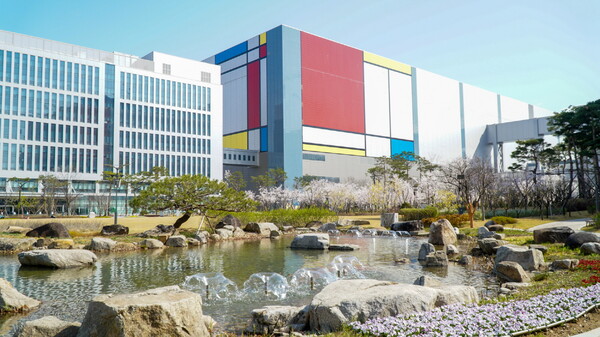
Samsung Electronics is building the 'NRD-K' R&D complex at its Giheung campus. The company said it plans to focus on improving investment efficiency as part of expanding the foundation for future production.
 Dae-geon Seok
d2dg@d-today.co.kr
Dae-geon Seok
d2dg@d-today.co.kr