
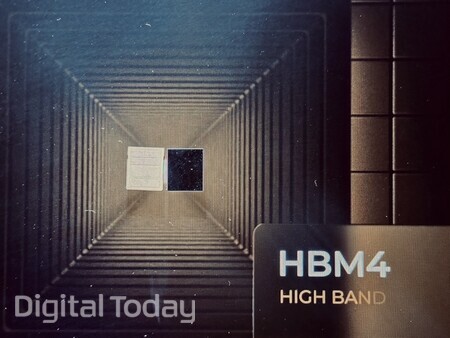
Uncertainty appears to be growing around the next-generation high bandwidth memory (HBM) market.
The industry says the shift from HBM4 toward company-optimised "custom HBM" is accelerating, while access to supply chain information is becoming harder as only customers and manufacturers share exact specifications and schedules.
Taiwan's DigiTimes reported last month that SK Hynix delayed the start of mass production of HBM4 to the third quarter of 2026 from the end of the second quarter of 2026 due to changes in Nvidia's plan for launching Rubin AI accelerators. SK Hynix moved to quell the controversy directly on its earnings conference call. It said HBM4 is proceeding as scheduled under a timetable agreed with customers and that it is currently mass-producing volumes requested by customers.
Questions in the market over supply stability largely stem from lower information transparency as the custom HBM era takes hold from HBM4. Up to HBM3E, specifications were disclosed under standards set by the Joint Electron Device Engineering Council (JEDEC). From HBM4, key information shifted to being undisclosed as customised logic dies (base dies) designed for each customer are used.
A more complex supply chain structure is also fueling debate in the market. Up to HBM3E, memory makers produced chips and supplied them to GPU companies in a simple structure. From HBM4, three-way cooperation is needed among fabless companies (design), foundries (production) and memory makers (HBM). Song Hyun-jong (송현종), president of SK Hynix, said that from HBM4 onward, the market has moved beyond simple stacking competition and that custom HBM combining base-die advanced processes and system optimisation has emerged as a key competitive factor.
SK Hynix said its main product to be produced this year is 12-high HBM3E and that it expects a gradual move to HBM4. The memory semiconductor market in 2026 can be seen as a transition period in which AI infrastructure expansion, demand centered on HBM3E and a gradual shift to HBM4 proceed at the same time. In this transition, HBM4, which goes through multiple processing stages, has become harder for outsiders to track in terms of progress.
Information asymmetry surrounding next-generation HBM products is also increasing supply uncertainty. In custom HBM, only chips that meet specific customer requirements are recognised as good products, so even if they are physically normal, they are treated as defective if they fall short of the criteria. In such cases, HBM4 made for a specific customer cannot be sold to another company, removing inventory flexibility. That structure means small production disruptions can immediately lead to concerns about supply disruption.
On its earnings conference call, SK Hynix said most customers are struggling to secure memory volumes due to an extreme supply-demand imbalance and are continuously demanding an expansion of supply. It added that inventories, in a situation where products are sold as they are produced, will fall further into the second half of this year.
Inventory flexibility disappears, progress differs by project, making supply and demand outlook hard.
The industry expects customisation to intensify from HBM4 to HBM4E and HBM5. As the shift to the custom HBM era continues, companies are increasingly managing detailed specifications under non-disclosure agreements (NDAs). Song said the company is actively holding discussions on custom HBM technology with major customers and is preparing to supply optimal products through "one-team" cooperation with partners.
By Song's account, only customers and manufacturers ultimately share accurate development schedules and specifications, limiting access to information for market participants. An industry official said that in the past, supply and demand conditions could be gauged through standard specifications and spot prices, but that custom HBM differs in progress by project. The official said those characteristics are heightening market sensitivity over memory supply stability.
 Seok Dae-geon
d2dg@d-today.co.kr
Seok Dae-geon
d2dg@d-today.co.kr