
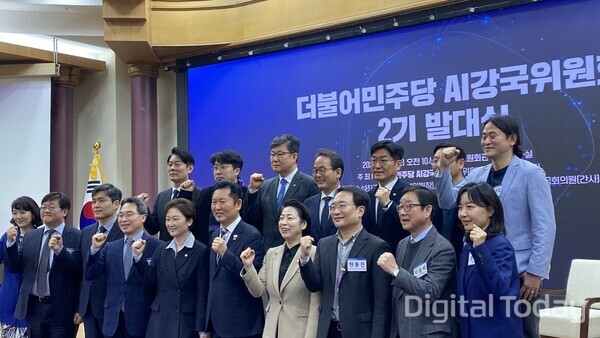
The second term of the Democratic Party's AI Powerhouse Committee has been launched. With the AI Basic Act taking effect in January, follow-up legislative tasks remain, including an unclear scope for high-impact AI, gaps in rules on AI bias, and issues over copyright and data learning, drawing attention to the committee's role.
At the National Assembly in Yeouido on Tuesday, party leader Jung Cheong-rae (정청래), who chairs the committee, said the change between the eras before and after AI would be bigger than the change before and after the internet. He said he was confident the dream of becoming one of the world's top 3 AI powers was becoming reality. He set a goal of securing a sole third-place position within the term of the Lee Jae-myung government.
The committee's second term will be led by lawmaker Lee Eon-ju (이언주) as senior vice chair. It will operate with two divisions: an industry, economy and science and technology division and a global AI and social transition division. Each division plans to hold a seminar or forum once a month. Opinions gathered through committee activities will later be linked to legislation.
Lee, the party's senior supreme council member, said that as the ruling party, the leader and leadership would faithfully carry out the role of delivering ideas to the presidential office and the government. She stressed she would provide momentum for the government's AI policy.
Tasks were also presented for each division. The industry division will have lawmaker Hwang Jeong-a (황정아) as secretary, with Baek Jun-ho (백준호), CEO of FuriosaAI, Hyun Dong-jin (현동진), an executive director at Hyundai Motor Group Robotics Lab, Park Jong-bae (박종배), a professor in the Department of Electrical and Electronic Engineering at Konkuk University, and Son Byung-hee (손병희), head of the Maum AI Research Institute, participating as vice chairs.
Key tasks include localising AI semiconductors, easing power grid regulations and building a data foundation for physical AI. Baek estimated expected AI infrastructure investment in North America and China over the next 3 years at about 3,000 trillion won and stressed that localising domestic AI semiconductors was essential. Park said power consumption by domestic AI data centres is only about one-22nd of the U.S. level, and proposed inducing locations outside the capital region, a fast track for power system capability assessments, and adopting a co-location strategy of building power plants and data centres together.
Son said the most important thing in the era of physical AI is industrial data, and cited building data factories as a task. Hyun said technology can be sustained only if it exists within an ecosystem, beyond simple products or services.
The global AI and social transition division will have lawmaker Cha Ji-ho (차지호) as secretary, with Seo Jun-beom (서준범), a professor at the University of Ulsan, Ko Sam-seok (고삼석), a chair professor at Dongguk University's Graduate School of Advanced Convergence, Ahn Seon-ha (안선하), an adviser to the World Health Organization, and Park Sung-pil (박성필), dean of KAIST's Graduate School of Future Strategy, participating. Key tasks include innovation in healthcare AI, combining K-content with AI, protecting vulnerable groups and improving intellectual property systems.
Cha said the share of tertiary industry in global GDP is 58 percent for South Korea and 80 percent for the United States. He said AI transformation in service areas such as healthcare, education and finance would become a major global market, no less than physical AI. He also projected that the unmet healthcare market in developing countries would grow to about 2,000 trillion won around 2032 and stressed that AI-based medical systems can be exported. On job transitions, he said the total volume would not shrink but patterns would change sharply, and raised the need for cushioning policies such as AI transition insurance.
Seo said combining South Korea's national health insurance data with public data from HIRA and the National Health Insurance Service could provide differentiated competitiveness. He said if the country successfully carries out a major shift to medical AI, it could become a global standard. Park cited copyright issues related to AI training data as a key task and said from a proactive governance perspective, AI-related legislation will play a key role in advancing to an AI powerhouse.
Based on these tasks, the party plans to push related legislation at speed. Specifically, it is set to pursue balanced growth outside the capital region through special cases for direct power purchases, resolve power challenges for AI data centres, provide one-stop resolution for physical AI regulations, foster the AI semiconductor ecosystem, and form task forces by issue and hold a series of meetings.
Hwang said a day of delay in the AI revolution, which she compared to the discovery of fire, puts a generation behind, and said she would enter a race against time to become a top 3 AI power. She said, however, that the direction for the legislative approach has not yet been set. She said further discussion is needed on whether to pursue follow-up legislation to the AI Basic Act or to push individual bills.
The inauguration ceremony was held in Meeting Room 1 of the National Assembly Members' Office Building, attended by Democratic Party lawmakers Jung, Lee, Kang Jun-hyeon (강준현), Han Min-soo (한민수), Kim Young-hwan (김영환), Park Hae-cheol (박해철), Kim Nam-geun (김남근), Hwang and Cha, along with committee-related figures including Baek of FuriosaAI, Hyundai Motor Group executive director Hyun, Konkuk University professor Park, Maum AI Research Institute head Son, University of Ulsan professor Seo, Dongguk University professor Ko, WHO adviser Ahn and KAIST professor Park.
 Seul-gi Son
sageson@d-today.co.kr
Seul-gi Son
sageson@d-today.co.kr