
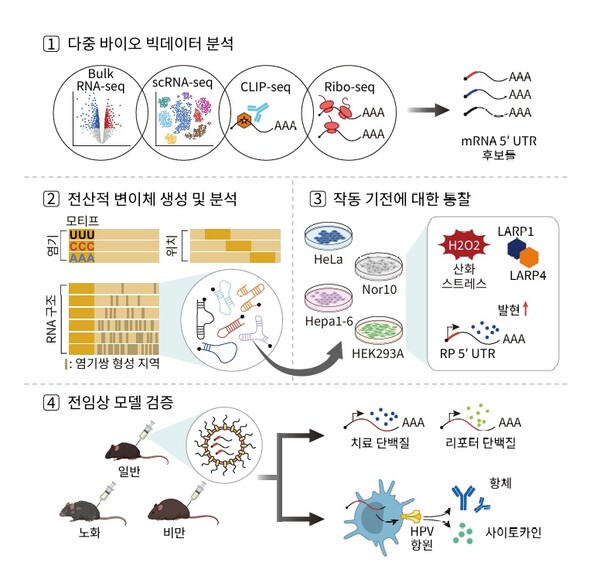
KAIST said on Monday that a joint research team led by Young-seok Lee (이영석), a professor in the Department of Bio and Brain Engineering, and Jae-hwan Nam (남재환), a professor at The Catholic University of Korea, developed a new mRNA platform by precisely designing sequences in the 5' untranslated region (UTR), a core regulatory area of messenger RNA (mRNA).
The 5' UTR is the section of mRNA that initiates protein production and regulates its efficiency. Depending on how it is designed, the amount and speed of protein production can vary. By analysing large-scale bioinformatics data, the researchers identified 5' UTR sequences that enable more efficient protein production across diverse cellular environments.
mRNA is a long, single-stranded RNA molecule that serves as a production blueprint for proteins needed in the body. It consists of the 5' UTR, which starts and regulates the pace of protein production; the protein-coding sequence (CDS), which contains information for a specific protein; the 3' UTR, which helps mRNA remain stable inside cells; and a poly(A) tail that boosts stability and supports protein production.
Among these, the 5' UTR and 3' UTR are important sections that regulate how efficiently proteins are produced. Because of these features, the two regions are drawing attention as core bioengineering platform technologies to improve the performance of various mRNA medicines, including vaccines and therapeutics.
To find 5' UTR sequences with strong protein production capability across multiple tissues and cellular environments, the team conducted integrated analysis of large-scale biological data. It used a range of methods, including tissue transcriptome analysis (RNA-seq) to assess gene activity, single-cell transcriptome analysis (scRNA-seq) to examine gene expression at the individual cell level, and ribosome profiling (Ribo-seq) to measure actual protein translation efficiency.
The researchers focused on the possibility that in ageing or obesity, cells can experience more stress and their ability to produce proteins may decline. When the newly designed mRNA therapeutic was applied to preclinical ageing and obesity models, the team confirmed that cellular protein production capacity and immune responses improved significantly compared with existing approaches.
Young-seok Lee of KAIST said, "This technology will be an important foundation for helping mRNA vaccines and therapeutics work well even in environments where drug efficacy may drop, such as in older people or patients with obesity."
The results of the study, with Soo-bin Yoon (윤수빈) of The Catholic University of Korea and Hyeong-gon Cho (조형곤), a KAIST doctoral student, as co-first authors, were published online on Jan. 2 in the gene and cell therapy journal Molecular Therapy.
The study was supported by the Ministry of Science and ICT and the National Research Foundation of Korea through its Excellent Young Researchers programme and Biomedicine Development Programme, by the Ministry of Food and Drug Safety through a support research programme for innovative technologies to respond to infectious diseases, and by the Korea Health Industry Development Institute through its technology development programme for prevention and treatment of infectious diseases.
 Jin-ho Lee
jhlee26@d-today.co.kr
Jin-ho Lee
jhlee26@d-today.co.kr