
Sales at nearby small merchants rose sharply after the Ministry of Oceans and Fisheries moved to Busan's Dong-gu district, the data showed.
Korea Credit Data (KCD), which operates the small business super app Cashnote, said on Sunday it analysed sales data for small merchants in Busan over 10 weeks before and after the ministry's relocation.
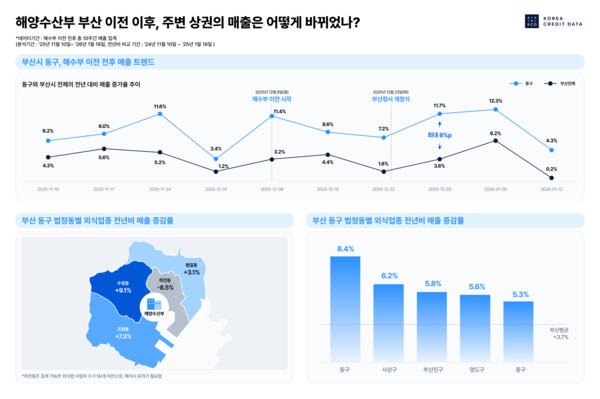
The analysis showed average weekly sales in Dong-gu, where the ministry is located, rose an average 8 percent from a year earlier. From Dec. 8 last year, when the relocation began, Dong-gu's year-on-year sales growth exceeded the overall growth rate for Busan.
Dong-gu posted the highest sales growth rate among Busan's districts during the period. By average store sales, Busanjin-gu, Haeundae-gu and Dongnae-gu ranked highest. But Dong-gu saw the biggest year-on-year increase in sales, meaning it was the district where business conditions improved the most from last year. That confirmed in the numbers the effect of the relocation in revitalising the local commercial area.
The commercial area in Busan's Dong-gu, where the ministry relocated, has a high share of food service, retail and services. Sales across all sectors in Dong-gu were most concentrated during lunchtime from 11 a.m. to 2 p.m., and weekday sales accounted for a large share. That suggests sales are likely to rise if additional administrative and business facilities are added.
Restaurant sales rose notably in Sujeong-dong, where the ministry building is located, and nearby Choryang-dong. Sujeong-dong restaurant sales rose 9.1 percent from a year earlier and Choryang-dong rose 7.3 percent, leading Dong-gu's commercial recovery. Average spend per table in Dong-gu restaurants was about 52,000 won. The data suggest a real increase in spending centred on lunch and dinner.
Kang Ye-won (강예원), data chief at Korea Credit Data, said, "This is a case showing that the relocation of a large administrative institution can create not only a symbolic move but also new vitality in the region and tangible economic effects for alleyway commercial districts." She added, "Data confirm the positive ripple effects of public-institution relocations on the local economy, in that the transfer of administrative and business functions is translating into daily sales for local small merchants."
 Lee Ji-young
ljy@d-today.co.kr
Lee Ji-young
ljy@d-today.co.kr