
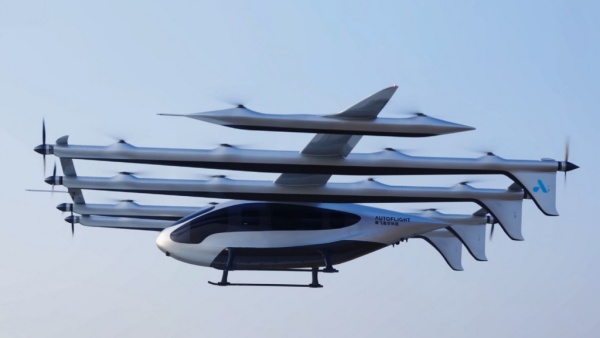
[DigitalToday reporter Jinju Hong (홍진주)] China's aviation startup AutoFlight, backed by support from the world's largest battery company CATL, has made a full-scale entry into the electric vertical takeoff and landing (eVTOL) market. This is interpreted as part of China's national-level "low-altitude economy" strategy.
On Feb. 8 local time, the Hong Kong-based South China Morning Post reported that Shanghai-based AutoFlight recently unveiled its 5-tonne eVTOL, Matrix, and completed a flight demonstration at a test facility in Kunshan near Shanghai. Matrix has a 20-metre wingspan, a fuselage length of 17.1 metres and a height of 3.3 metres. It is a large aircraft developed for 10-passenger transport and heavy cargo operations. Compared with existing eVTOLs, which have largely remained in the 1.5 to 3-tonne class with 4 to 6 seats, it represents a dramatic increase in size.
AutoFlight is cited as a key company leading China's eVTOL market alongside EHang, AeroHT, the flying-car unit of Xpeng, and Geely's Aerofugia. The Chinese government is also accelerating institutional revisions to promote the low-altitude economy. Recently, 10 government bodies including the market regulator and the transport ministry announced guidelines to establish basic criteria by 2027 and set more than 300 aviation standards by 2030. The plan covers five core areas, from aircraft development to infrastructure, air traffic management, safety supervision and use cases.
Founded in 2017, AutoFlight initially focused on cargo transport but plans to expand into passenger transport. Passenger aircraft orders now account for about 70% of total orders, and it expects to obtain passenger certification within 1 to 2 years. Commercial eVTOLs must go through three procedures: design certification, production certification and airworthiness certification for each aircraft.
Its existing models, CarryAll and Prosperity, are aircraft for autonomous logistics and air mobility, respectively. Among them, the 2-tonne cargo aircraft CarryAll is the only tonne-class eVTOL in China to have obtained all three aviation certifications. It recently completed a cargo transport flight of about 160 km from Anqing to Hefei.
CATL is AutoFlight's largest shareholder, holding a 38% stake, and is fully supporting battery research and development. The industry sees this year as a turning point for eVTOL companies shifting from the prototype stage to commercial products. Research firm CCID Consulting expects China's first flying-car passenger transport to begin in 2026, and forecast that at least 7 manufacturers will launch commercial models this year alone.
AutoFlight aims to reduce air mobility costs to the level of premium ground ride-hailing services and plans to pursue large-scale commercialisation within 3 to 5 years. It is also reviewing entry into overseas markets, focusing on regions with insufficient infrastructure, and is targeting Northeast Asia, Southeast Asia and the Middle East as key markets.
 Jinju Hong
hongjj@d-today.co.kr
Jinju Hong
hongjj@d-today.co.kr