
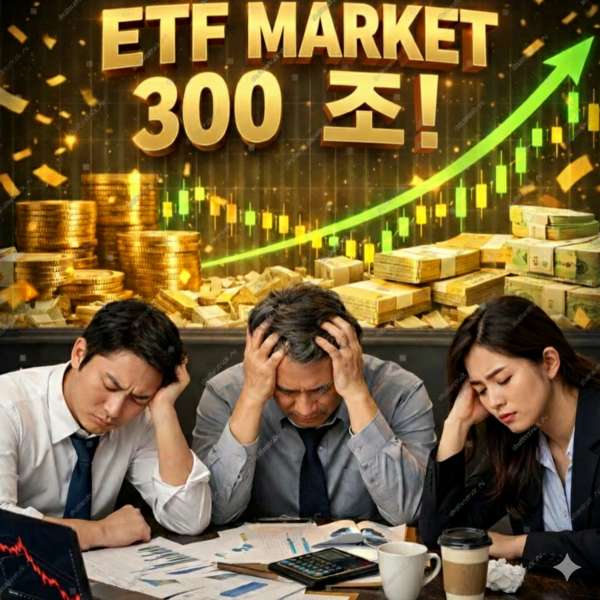
[Digital Today reporter Sangyeop Oh] The exchange-traded fund (ETF) market has entered an era of 300 trillion won in net assets, but asset managers' worries are deepening. As the rush of money into ETFs accelerates, a battle to cut fees is turning into a "chicken game."
As of Feb. 9, the financial investment industry said more than 60 percent of funds flowing into South Korea's domestic public fund market in 2025, excluding money market funds, went into ETFs.
Of about 100 trillion won in net inflows to the overall public fund market last year, around 61 trillion won went to ETFs. ETFs quickly filled the gap as active equity funds, once the mainstay of the fund market, were shunned due to weak returns and inconvenient subscription procedures.
As of Jan. 30, total net assets in ETFs stood at 348.46 trillion won, up 51.32 trillion won, or 17.27 percent, from 297.14 trillion won at the end of last year. The 400 trillion won mark is close at hand. With the market's balance fully tilting toward ETFs, the public fund market has effectively become an "ETF world."
The problem is that the larger the market gets, the more asset managers' profitability worsens. A bruising battle to gain market share has led to fee cuts that amount to self-harm.
In practice, major firms such as Samsung Asset Management and Mirae Asset Management have lowered total fees on ETFs tracking major U.S. benchmarks or on parking-type ETFs to around 0.01 percent. Some managers cut fees to about 0.0099 percent a year, breaking even the 0.01 percent barrier.
The industry points out that for products with management fees around 0.01 percent, even if 1 trillion won is raised, an asset manager's annual revenue is only about 100 million won. After marketing costs, there is effectively nothing left.
By contrast, general equity funds typically charge management fees of around 0.5 to 0.7 percent a year. By simple calculation, running 100 billion won in a general fund can generate more revenue for an asset manager than running 1 trillion won in an ETF.
ETFs must also pay index licensing fees to index providers for the benchmarks they track, such as the KOSPI and the S&P 500. Intense competition for market share also increases spending on brand advertising, event costs and liquidity provider costs, creating a structure in which selling more can mean losing more.
That means it is difficult for asset managers to translate the ETF market's scale of more than 300 trillion won into real profitability gains.
Financial authorities and the industry, feeling a sense of crisis, have rolled out the card of "direct listing of public funds." The system, first introduced on Oct. 27 last year, allows existing public funds to be listed on the stock market like ETFs so they can be traded in real time.
Under the system, investors can trade existing funds in the form of an "X class (listed class)" on mobile trading systems (MTS), instead of visiting bank or brokerage branches and going through complicated subscription procedures. The core is cutting sales fees and commission costs while sharply shortening redemption cycles.
Experts advise that for public funds to survive, they need fundamental differentiation in investment strategy beyond simply improving trading convenience.
Jinyoung Kim (김진영), a research fellow at the Korea Capital Market Institute, said, "In a situation where ETFs lead the market, general public funds must have portfolio strategies differentiated from ETFs to survive." He said, "Through active management that moves beyond index tracking, they must provide diverse investment opportunities that ETFs cannot offer."
Kim added, "The higher the level of portfolio differentiation for general public funds, the more positive the impact on fund flows." He added, "Analysis shows that the lower the overlap of holdings with ETFs, the more new money flows in from investors, or the smaller the outflows."
 Sangyeop Oh
yub@d-today.co.kr
Sangyeop Oh
yub@d-today.co.kr