
South Korea's financial authorities, in line with the government's push to revitalise capital markets, are reviewing a plan to include so-called penny stocks, shares priced below 1,000 won, in delisting requirements.
The aim is to boost trust in capital markets by boldly clearing out "rotten products". The pace at which distressed firms leave and enter the market is expected to accelerate further.
According to the Korea Exchange on Saturday, as of Feb. 6 there were 170 penny stocks listed on the KOSDAQ market, accounting for about 10 percent of the total 1,822 issues.
That was slightly down from 178 as of the start of this year (Jan. 2), but up 38.2 percent compared with the start of 2024 (123) over about two years.
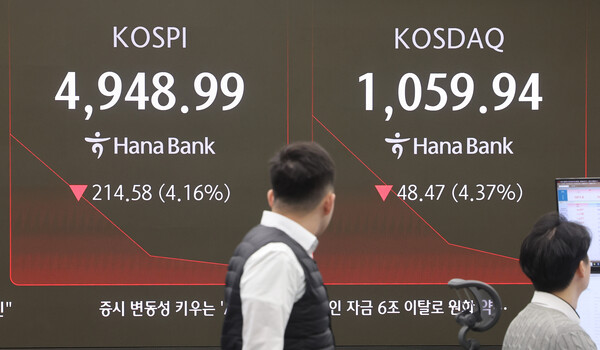
Over the same period, the KOSDAQ index rose to 1,080.77 from 878.93, but the number of penny stocks increased.
When the KOSDAQ index hit a two-year low of 627.01 on Dec. 9, 2024, the number of penny stocks stood at 219.
In the KOSPI market, 56 issues were classified as penny stocks as of Feb. 6.
Penny stocks priced below the value of a single banknote are highly volatile and carry a high risk of delisting. They could also be abused by market manipulators or for backdoor listings.
The financial authorities are also reviewing a plan to delist penny stocks. Currently, delistings are decided based on requirements including market capitalisation and revenue.
Financial Services Commission Chairman Lee Eok-won (이억원) stressed at a National Assembly Political Affairs Committee briefing on Feb. 5 that "on the U.S. Nasdaq, 'penny stocks' (issues priced below $1) are also delisting criteria," adding, "We will boldly introduce this to clearly clear out rotten products and fake products so that innovative products can be placed in their stead."
President Lee Jae-myung (이재명) stressed in a post on X (formerly Twitter) late last month that "(in a department store (stock exchange)) it is urgent to firmly start with clearing products and quickly introduce good new products to restore customer trust," adding momentum to related discussions.
On Nasdaq, a stock priced below $1 for 30 consecutive trading days meets delisting criteria.
A company can maintain its listing if the stock price exceeds $1 for 10 consecutive days during a 180-day compliance period, but if it does not recover it is delisted.
The financial authorities are expected to draw up a delisting plan suited to the situation of South Korea's stock market by referring to the U.S. case.
A financial authorities official said, "We are discussing specific measures for delisting penny stocks," adding, "We plan to push it quickly."
Experts said they agreed with the direction of delisting penny stocks, but that objective standards are needed to screen out "distressed" penny stocks.
Kim Dae-jong (김대종), a professor of business administration at Sejong University, said, "For a sound stock market, there is a need to swiftly clear out penny stocks and distressed firms," but added, "In some cases, the stock price may not properly reflect asset value, so considering asset value as a standard is also an option."
There were also calls to invigorate the trading market for unlisted shares to reduce investor losses from delisting penny stocks.
Lee Hyo-seop (이효섭), a research fellow at the Korea Capital Market Institute, said, "If regulations are rationally improved for unlisted trading markets such as the over-the-counter market (K-OTC), trading in delisted issues can become active," adding, "There is a need to design a system so they can grow again if sales or performance improve later."
[Yonhap News Agency]
 Online Team
d-today@d-today.co.kr
Online Team
d-today@d-today.co.kr