
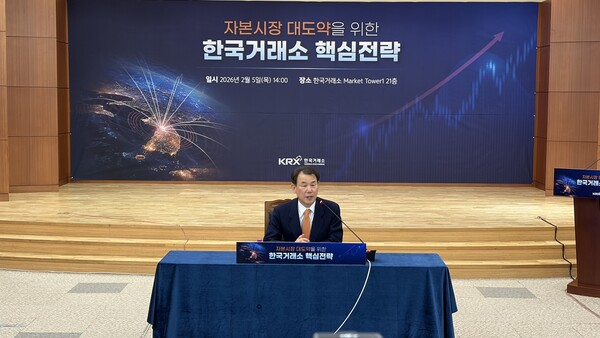
The Korea Exchange has set out steps to entrench a KOSPI 5,000 era and relaunch the capital market. It plans to speed up the removal of weak listed firms, often called "zombie companies," and introduce a pre- and after-market that significantly extends stock trading hours from June.
Korea Exchange Chairman Jeong Eun-bo (정은보) on Feb. 5 held a New Year news conference at the exchange's Seoul office in Yeouido, Seoul. He announced the "2026 core strategy for a major leap in the capital market."
Jeong presented 4 key strategies and 12 action tasks: raising trust in the capital market, shifting to productive finance, strengthening global competitiveness and securing future growth drivers.
Jeong stressed, "Our capital market stands at a turning point for a major leap, and the Korea Exchange will concentrate all its capabilities on advancing the capital market toward a Korea premium."
Speeding up the exit of weak firms... tougher delisting standards
The exchange cited early removal of weak firms as a top priority for restoring trust in the capital market. In step with the government's push to eliminate zombie companies, it aims to break the cycle in which marginal firms remain in the market and increase investor losses.
Jeong said the KOSDAQ index started at 1,000 when the market was launched in 1996 and rose to 2,800 in 2000 before falling to around 400 after the bubble burst. He added that while it has recently recovered the 1,000 level, companies that remain in the market despite failed business models are still holding back gains in the index.
To that end, the exchange is continuously tightening delisting standards, including market capitalisation and revenue. Starting this year, it began applying higher thresholds for designation as a supervised issue and for delisting requirements due to failing to meet market capitalisation standards. It also plans to reinforce the organisation and staffing in charge of delisting reviews to speed up the exit process.
It will also upgrade its surveillance system to eradicate unfair trading. The exchange plans to strengthen coordination with a joint response team involving related agencies, including the Financial Services Commission and the Financial Supervisory Service, and build a next-generation market surveillance system that incorporates artificial intelligence to detect early signs of unfair trading such as stock price manipulation.
From June, 'pre- and after-market'... launch of a 24-hour trading system
The exchange will also overhaul trading rules to attract global capital and improve investor convenience. The most notable change is the expansion of trading hours. It aims to open a "Pre-Market/After-Market" for the stock market by June 2026.
Kim Jung-young (김정영), an executive director at the Korea Exchange's Management Support Division, said the move is intended to activate trading during commuting hours for individual investors, including office workers, and to resolve time-zone differences with overseas markets such as the United States. He said the exchange will pursue the phased introduction of a 24-hour trading system to significantly improve global investors' access to the domestic market.
The move responds to intensified competition among global exchanges to secure liquidity, with the New York Stock Exchange and Nasdaq moving quickly to introduce 24-hour trading systems targeting Asian investors.
The exchange plans to expand night trading for derivatives to complete the foundation for 24-hour trading. It also plans to shorten the stock market settlement cycle to align with global standards.
Efforts to be included in the Morgan Stanley Capital International (MSCI) developed markets index will also continue.
Beyond the second phase of mandatory English disclosures implemented this year, it is preparing to bring forward the third phase from 2027, in which all KOSPI-listed companies participate in English disclosures. It will also strengthen incentives by giving additional points when selecting "value-up" best companies for firms that improve dividend procedures and by expanding dividend payouts of index usage fees.
Support for productive finance... lower listing hurdles for AI and advanced-technology firms
To secure future growth drivers, the exchange will also push to shift the capital market's structure to "productive finance." It plans to set tailored listing requirements and raise review expertise so that advanced-technology firms such as those in AI can raise funds smoothly.
To support innovative companies with high growth potential, it will promptly support the introduction of business development companies (BDCs) and strengthen its function of incubating unlisted companies.
It plans to reorganise the KOSDAQ division's structure and staffing to enhance expertise and independence, and introduce a separate management evaluation system to strictly manage performance in supporting innovative companies.
Kim said, "To revitalise venture capital, we will actively use a pool of experts so that technology evaluations for firms listed under technology special provisions and others can be conducted more professionally and objectively."
To strengthen the exchange's own competitiveness, it will also push to introduce AI across its operations. It aims to improve the efficiency of market management and strengthen capabilities in data and index businesses to diversify its revenue structure.
It plans to quickly introduce single-stock futures and leveraged exchange-traded funds (ETFs) that had been traded only overseas, and expand the lineup of new products such as weekly options. It is also preparing to open a futures market for emissions permits to support carbon neutrality policies.
Strengthening Busan's status as a financial hub... derivatives market 30th anniversary relaunch
It will also strengthen its role as an organisation headquartered in Busan. Marking the 30th anniversary of the opening of the derivatives market this year, it plans to broaden the base of derivatives investment and raise Busan's status as a financial hub by fostering marine and financial innovative companies.
Jeong said South Korea's capital market has achieved quantitative growth, with the KOSPI surpassing 5,000 points for the first time and the KOSDAQ recovering 1,000 points. He said it is now time to remove the Korea discount through qualitative growth and make the leap to a truly advanced capital market.
He added that if the government's value-up programme and the exchange's core strategies create synergy, the market can resolve factors behind undervaluation and be reborn as a market trusted by investors.
At the news conference, questions were also raised about a debate over the effectiveness of longer trading hours. Jeong said a phased extension of trading hours is essential to bring overseas liquidity into the domestic market, and added the exchange decided to start the pre- and after-market from late June in consideration of IT infrastructure and other factors.
On the undervaluation of the KOSDAQ market, Jeong said that while many companies have been listed, firms that failed to establish their business models still remain and are the main factor holding back index gains. He again stressed that the clean-up of weak firms must come first for the market to restore investor trust and receive proper valuations.
 Oh Sang-yup
yub@d-today.co.kr
Oh Sang-yup
yub@d-today.co.kr