
K Bank plans to use its initial public offering as a springboard to enter the SME market for sole proprietors and small and medium-sized companies, expand platform businesses and strengthen competitiveness in digital assets. It aims to pour capital raised through the listing into future growth engines and sharply broaden its business portfolio.
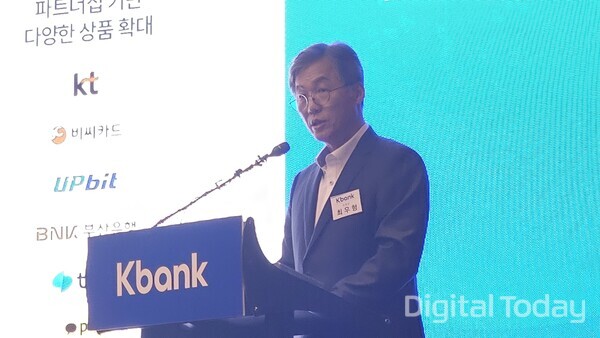
K Bank CEO Choi Woo-hyung (최우형) held a media briefing at the Conrad hotel in Seoul on Wednesday and said K Bank would list on the KOSPI market on March 5, a month from now. He said the listing would be the starting point for K Bank's next phase of growth.
K Bank plans to use funds raised through the IPO to strengthen the competitiveness of its deposit and loan products while focusing on a full-scale push into the SME market, strengthening tech leadership, expanding platform businesses and investing in new businesses such as digital assets.
It will first expand its household-loan-focused portfolio into the SME segment. It aims to diversify its earnings structure by balancing household and SME exposure at about 50-50 by 2030.
To do that, it will upgrade its credit scoring system and strengthen its lineup of SME-only products. It will use its non-face-to-face real-estate-secured loan for sole proprietors, launched as an industry first, as a growth pillar while pursuing asset quality and balance-sheet expansion at the same time.
Choi said retail customers remain a core pillar for K Bank. He said it would continue to expand its customer base and monthly active users by growing signature products and entering new markets such as foreign customers and minors.
Expanding platform businesses is also a key investment area. It plans to broaden partnership financial services with large platforms such as Musinsa and speed up building a financial lifestyle platform that combines customer traffic with partnerships. He stressed he would complete a platform ecosystem that combines finance and daily life based on an open ecosystem.
It will also gradually expand SME lending. This year it plans to broaden the collateral scope for its small-business real-estate-secured loan, reinforce guaranteed loan products and prepare to enter the small and medium-sized corporate loan market. Choi said it plans to introduce the country's first non-face-to-face corporate loan product for small and medium-sized firms in 2027.
◆ The next card in the growth strategy is 'stablecoin'
Based on IPO funds, it will also step up investment in digital assets, a next-generation growth pillar.
K Bank's strategy is to expand alternative investment products such as virtual assets and gold beyond stocks and bonds, while developing digital asset infrastructure as a key future business.
It will in particular accelerate the build-out of overseas remittance and payment infrastructure using stablecoins. After listing, it plans to deploy capital into expanding dedicated teams and internalising technology, aiming to leap into a global digital finance hub.
Choi said it plans to issue a stablecoin by taking a leading role in a banking consortium once legislation is finalised. He said K Bank would become the bank that benefits most from the stablecoin market, which is expected to grow explosively.
It also plans to quickly broaden use cases. It aims to build a stablecoin-based overseas remittance and payment network through BC Card's payment infrastructure and cooperation with global financial companies and digital asset firms.
K Bank has already signed MOUs with a United Arab Emirates digital asset firm and Thailand's Kasikornbank and has begun building related infrastructure. On Wednesday it also unveiled for the first time a demonstration video of stablecoin-based overseas remittances.
Choi said blockchain technology has innovated the complex intermediary structure of existing overseas remittances. He said processing time that takes several days would become real time and fees that were tens of thousands of won would fall to near-free levels, greatly increasing customer efficiency.
K Bank plans to expand overseas partnerships in line with the establishment of a regulatory environment and push ahead in earnest with commercialising digital-asset-based financial services.
It will also continue to invest in tech leadership, including expanding AI infrastructure, upgrading its app and strengthening information security systems.
K Bank's IPO will offer 60 million shares, with an indicative price range of 8,300 won to 9,500 won per share. At the top end, the offering would raise about 570 billion won, and the capital inflow effect reflected in the BIS ratio after the listing is expected to be about 1 trillion won.
K Bank will run bookbuilding through Feb. 10 and set the offering price on Feb. 12. Retail subscriptions will run from Feb. 20 to Feb. 23, and the listing date is March 5.
Choi said it prepared a shareholder-friendly offering structure by lowering the offering price compared with the previous level and adjusting the amount of freely tradable shares on the listing day to reflect market expectations. He said it would strengthen its capabilities based on secured capital and become an innovative financial company trusted by both customers and shareholders.
 Lee Ji-young
ljy@d-today.co.kr
Lee Ji-young
ljy@d-today.co.kr