
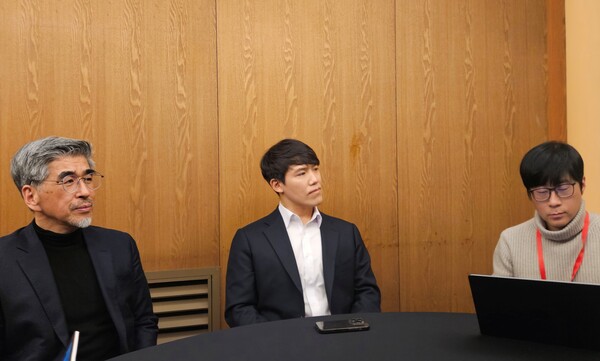
Oracle Cloud Infrastructure (OCI) is quickly building a presence among promising South Korean startups. It is being credited with supporting service expansion for startups in a growth phase by offering high-performance, low-cost infrastructure.
Three South Korean AI startups - CryptoLab, LikeLion and TwoDigits - attended the recent Oracle AI Summit 2026 and shared why they adopted OCI and what they have achieved with it. They cited strong scalability and security, as well as proactive maintenance services, as OCI's key strengths.
CRYPTO LAB SAYS OCI IMPROVES SECURITY; "EASIER CORE SCALING"
Homomorphic encryption startup CryptoLab highlighted OCI's strong security and parallel computing performance. Seon-cheol Jeong (정선철), a director in CryptoLab's platform development team, said homomorphic encryption requires complex parallel processing. He said OCI delivered better parallel computing performance than other providers and made it easy to scale as needed.
CryptoLab is developing homomorphic encryption technology that enables data to be used while it remains encrypted. It recently launched an "InVector" service that enables vector-based search without decrypting the original data. It allows AI search without exposing sensitive data externally.
Jeong added that OCI was also advantageous in core scaling and network costs. He said CPU-based parallel processing is important given the nature of homomorphic encryption operations, and OCI offered high convenience for core scaling even on ARM instances. He said the free outbound traffic of up to 10TB per month was also a big help for startups.
CryptoLab currently supplies homomorphic encryption technology to Toss and major state institutions. The company aims to establish the technology as core infrastructure for industrial security.
LIKELION USES OCI TO RUN AI AGENTS
Use of OCI is also expanding in education. LikeLion, which operates an IT education community, runs its in-house learning management platform, the "AI Learning Experience Platform", in an OCI environment. It also optimises and operates various AI agents on OCI.
LikeLion operates multiple AI agents that support learning. They include "Leo", a learning partner that participates in classes, as well as an AI that generates content and an AI agent that automatically organises daily learning into summary notes.
A container-based microservices architecture (MSA) is essential for multiple AI agents to work together organically. LikeLion said OCI quickly supports an MSA environment and showed strengths in maintenance functions such as measuring network latency.
O-cheol Kwon (권오철), LikeLion's chief technology officer, said education services require stability around the clock and learning data is sensitive personal information. He said OCI inspired trust by providing security elements such as network separation and access controls as default settings.
LikeLion said it also confirmed OCI's stability during a large advertising campaign. Hundreds of thousands of people accessed an advertising event page featuring actor Hyun-jin Baek, but the campaign ran successfully without access disruptions. Kwon said OCI played a big role in responding flexibly to hard-to-predict traffic conditions.
TWODIGITS USES OCI TO TARGET U.S. MARKET
TwoDigits, a startup specialising in fine-tuning large language models (LLMs), chose OCI with global services in mind. TwoDigits is developing domain-specific AI models that can be used in environments with restricted internet connections, including finance, defence and public institutions. It was selected as a "promising AI startup for global market entry" in the AI startup LLM challenge hosted by the Ministry of Science and ICT and the Ministry of SMEs and Startups.
TwoDigits recently launched a beta version of an AI report service targeting U.S. stock investors. It uses an AI model specialised in financial data analysis to automatically generate reports twice a day on about 10,000 stocks.
Seok-jun Park (박석준), CEO of TwoDigits, said latency issues for U.S. users are inevitable if infrastructure is based in South Korea. He said OCI enabled the company to quickly prepare local services by offering a U.S. region on reasonable terms.
Park said the network cost savings were significant. He said OCI's cloud network costs are low, helping cut overall operating costs, and the company is also reviewing the possibility of linking with Oracle Database.
 Jin-ho Lee
jhlee26@d-today.co.kr
Jin-ho Lee
jhlee26@d-today.co.kr