
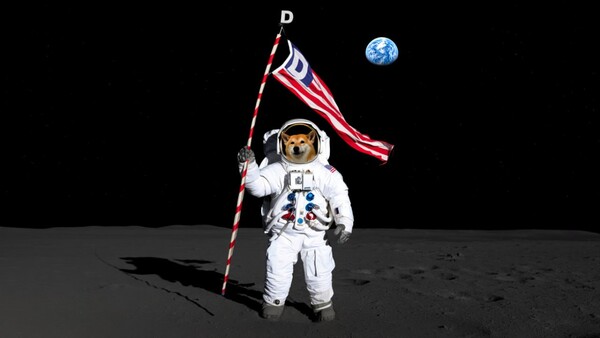
[DigitalToday reporter Yoonseo Lee] Elon Musk (일론 머스크), the world’s richest billionaire and head of Tesla, has reaffirmed his pledge to send Dogecoin (DOGE) to the moon. He said he plans to carry it out through SpaceX by 2027, drawing attention.
The Crypto Basic, a blockchain outlet, reported on Feb. 4 local time that Musk said the 'Dogecoin lunar mission' plan remains valid and mentioned the possibility of execution in 2027.
Musk said on X, formerly Twitter, that the 'Dogecoin lunar mission' plan announced in 2021 is still valid. He replied, "It could be possible as early as next year (2027)." In another post, he responded "Yes" to a claim that the Dogecoin lunar mission is inevitable, showing strong resolve for the project.
The slogan "Send Dogecoin to the moon" has been used as a meme meaning a rise in Dogecoin’s price, but the latest remarks have again drawn attention to whether it will be realised. Musk has mentioned the plan several times since 2021, and in November 2025 he also stressed, "Now is the time to do it." Market interest is focusing on whether SpaceX will actually carry out the 'first cryptocurrency-based exploration mission' to send Dogecoin to the moon.
The issue has not immediately changed market sentiment. Musk’s remarks drew short-term attention, but investors are watching more closely what form it will take and whether follow-up messages and moves to execute it follow. Market reaction could vary depending on whether the plan leads to action.
With Musk’s continued support, Dogecoin has been adopted as a payment option by Tesla and SpaceX, and he has also shown strong support for the Dogecoin Foundation. The impact of the latest remarks on Dogecoin’s price was limited. Immediately after the announcement, Dogecoin rose 1.68 percent to $0.1087 from $0.1069, but later slipped back to $0.1081.
In the market, interest tends to be reignited in the short term each time Musk repeats such remarks. Attention is on whether additional comments and disclosure of a follow-up schedule will act as a key driver of volatility.
Yes
 Yoonseo Lee
yslee@d-today.co.kr
Yoonseo Lee
yslee@d-today.co.kr