
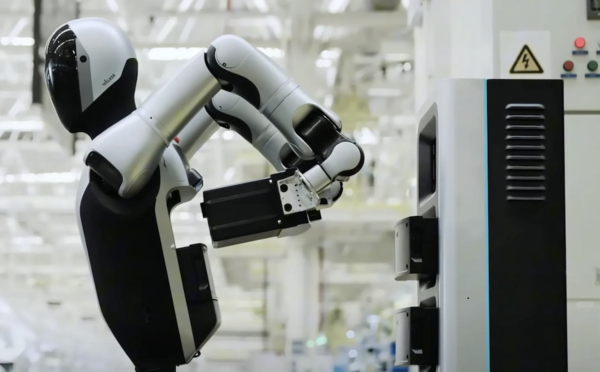
The battery industry has launched an all-out push across the value chain, from cell manufacturing to materials development, aiming for mass production of all-solid-state batteries in 2027. With energy density at about 1,000 Wh/L, the technology is seen as a game-changer for next-generation industries such as humanoids and drones. Whether mass production succeeds is expected to determine leadership in the global market.
At InterBattery 2026, the three cell makers Samsung SDI, LG Energy Solution and SK On, along with materials companies including Ecopro, L&F, Posco Future M and LG Chem, will simultaneously disclose the status of their all-solid-state development, the industry said. Competition is intensifying to secure high-energy-density, high-safety batteries essential for next-generation industries such as humanoid robots, drones, aircraft and satellites.
All-solid-state batteries are drawing attention because they can secure both energy density and safety. By replacing liquid electrolytes with solid ones, they fundamentally reduce fire risks while achieving energy density of about 1,000 Wh/L. Humanoids require long operating time along with compact, lightweight designs. For drones, extending flight time and ensuring safety are key. Current lithium-ion batteries remain at about 300 to 400 Wh/L.
Most humanoid robots currently operate for only 2 to 4 hours because battery capacity is generally below 2 kWh. The Unitree H1 runs for less than 4 hours in static operation with a 0.864 kWh battery, and Tesla's Optimus Gen2 has a 2.3 kWh high-nickel battery system but operates for about 2 hours during dynamic operation. Market research firm TrendForce analyzed that "a battery replacement strategy or adoption of high-energy-density battery technology is essential to break through the 5 to 8-hour battery life limit."
Expectations are high. Demand for all-solid-state batteries for humanoid robots is projected to reach 74 GWh in 2035. That is more than a 1,000-fold increase compared with 2026. Global humanoid robot shipments are expected to exceed 50,000 units in 2026, growing more than 700 percent from the previous year. TrendForce analyzed that "the commercialization of humanoid robots in 2026 will significantly accelerate demand for next-generation batteries" and that "energy storage, especially all-solid-state batteries, will play a key role."
◆Whether mass production succeeds in 2027 will decide global leadership
Samsung SDI is accelerating development of sulfide-based all-solid-state batteries with the goal of mass production in the second half of 2027. It plans to apply batteries with energy density of about 1,000 Wh/L to various forms of physical AI, including humanoids, mobile robots and industrial robots. Samsung SDI presented all-solid-state batteries as a solution, saying physical AI that must perform high-performance computing and precision movement at the same time requires high energy density, stable output and absolute safety.
LG Energy Solution will showcase a portfolio of next-generation battery technologies, including all-solid-state batteries as well as lithium-metal batteries, bipolar batteries and sodium batteries. It plans to exhibit all-solid-state battery technology to be applied to the home robot LG Cloi, Bear Robotics' autonomous driving robot Carti100, a blood-transport drone developed in cooperation with the K-Drone Alliance, and aircraft and cube satellites.
Materials development for commercialization of all-solid-state batteries has also gained momentum. Ecopro said it has established a full value chain for all-solid-state battery materials. It plans to unveil at InterBattery a solid electrolyte being developed with customers with a 2027 mass production target, along with cathode materials for all-solid-state batteries and lithium-metal anode materials. An Ecopro official said, "Based on global No. 1 high-nickel technology, we showcased a full lineup, including all-solid-state materials, to prepare for the humanoid era."
L&F will disclose its next-generation materials portfolio, including ASSB cathode materials for all-solid-state batteries. Posco Future M will exhibit its development status for cathode materials for all-solid-state batteries and silicon anode materials, and it will also introduce the status of open innovation research and development being conducted jointly with U.S. all-solid-state battery company Factorial Inc. Posco Group is also developing core all-solid-state materials, including solid electrolytes and lithium-metal anode materials.
LG Chem will present a portfolio spanning the full battery value chain, including various cathode materials such as high-nickel, high-voltage mid-nickel, LFP and LMR, along with ASSB cathode materials for all-solid-state batteries and anode binders. LG Chem CEO Dongchoon Kim (김동춘) said, "We will strengthen global market leadership with core materials competitiveness and technology-based integrated solutions."
The industry views 2027 as a turning point for commercialization of all-solid-state batteries. Companies that establish mass production systems during this period are expected to take the lead in next-generation markets such as humanoids and drones. The key is when mass production processes are stabilized and cost competitiveness is secured. With global competitors such as China's CATL and Japan's Toyota also actively developing all-solid-state batteries, maintaining the technology gap is seen as important.
An industry official said, "All-solid-state batteries are technically challenging, so close cooperation between cell makers and materials companies is essential," adding that "whether mass production succeeds in 2027 will determine K-batteries' leadership in next-generation markets."
 Daegeon Seok
d2dg@d-today.co.kr
Daegeon Seok
d2dg@d-today.co.kr