
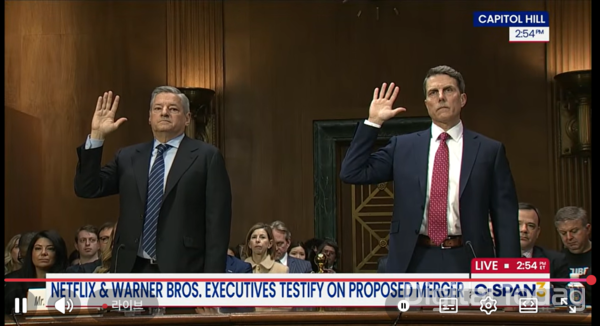
As the U.S. Congress pressed Netflix over its increase in overseas production, Netflix co-CEO Ted Sarandos (테드 사란도스) said production in South Korea "happens separate."
At a U.S. Senate Judiciary Committee antitrust subcommittee hearing on Feb. 3 (local time), Sarandos answered a question from Democratic Senator Adam Schiff of California by saying Netflix operates its service in South Korea and produces South Korean content "for the South Korean market."
Schiff said other studios increased production in the United States after the pandemic, but Netflix increased overseas production even more. He said he understood Netflix was building a facility in New Jersey and asked why more production was moving overseas.
Sarandos said local production in the Korean language with Korean actors and Korean crews happens separately. He added that, excluding that, most content investment takes place in the United States. Netflix has pledged to invest 5.5 trillion won in South Korea from 2021 to 2025, producing global hits such as "Squid Game" and "The Glory."
He said Disney recently moved an entire Avengers film to London. He said that thanks to incentives from the state of New Jersey, Netflix brought 7 of 11 projects that were headed for Britain back to the United States.
Dominant platform vs 10 percent market share
Lawmakers said they were concerned Netflix's planned $82.7 billion acquisition of Warner would strengthen its market dominance. Republican Senator Mike Lee of Utah, the antitrust subcommittee chairman, said Netflix wanted to become "the one platform to rule them all." It was a phrase parodying Warner's "The Lord of the Rings."
Democratic Senator Cory Booker of New Jersey, the subcommittee's ranking member, called it the worst corporate concentration since the Roosevelt era and described the merger as the worst monopoly in 120 years. In the early 1900s, President Theodore Roosevelt forced the breakup of monopolies including Standard Oil.
Lee warned that if the merged company exceeds 30 percent market share in the subscription video-on-demand market, it would be presumed illegal under U.S. Supreme Court precedent.
Sarandos countered that Netflix accounts for only 9 percent of total TV viewing time and 10 percent even after acquiring Warner. He said YouTube is the No. 1 platform by viewing time and stressed that YouTube is no longer just a cat video site but TV.
Bruce Campbell (브루스 캠벨), chief strategy officer at Warner Bros Discovery (WBD), said 80 percent of HBO Max subscribers already subscribe to Netflix. He said the merged company could offer the two services at a discounted price.
Theatres and rivals also raise concerns as DOJ begins full review
In a letter Lee previously sent to Netflix and Warner executives, he raised the possibility the deal could be a "killer non-acquisition" aimed at tying up and weakening rivals for a long time through an acquisition process, but he did not mention it directly at the hearing.
Concerns were also raised about a reduction in theatrical distribution. When Booker asked whether Netflix would keep a 45-day period of theatrical exclusivity, Sarandos answered it would keep 45 days as a full exclusive.
Final approval of the merger will be handled by the U.S. Justice Department's antitrust division. The DOJ ordered the companies to submit additional materials on Jan. 16 and began a full review. A Warner shareholder vote is scheduled for April, and the companies expect final approval of the acquisition to take 12 to 18 months.
 Seul-gi Son
sageson@d-today.co.kr
Seul-gi Son
sageson@d-today.co.kr