
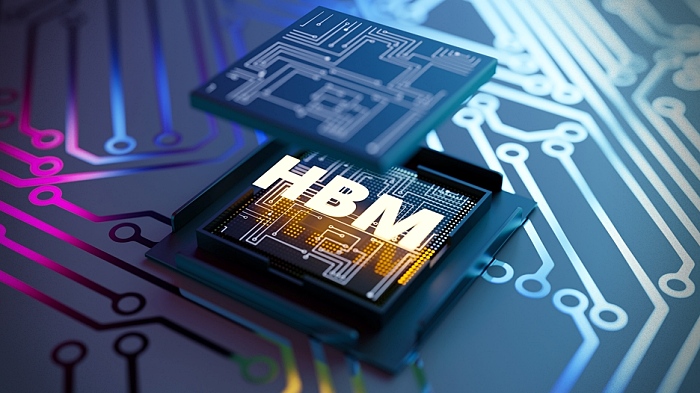
As AI infrastructure investment that surged last year is increasingly likely to slow in the first quarter of this year, the impact on the HBM market is expected to be unavoidable.
Goldman Sachs said on Tuesday that the 2026 capital expenditure consensus for hyperscaler companies hit a record high of $527 billion, but the growth rate has entered a slowdown phase. Capex growth rose as high as 75 percent year on year in the third quarter of last year, then fell to 49 percent in the fourth quarter. It is forecast to slow to 25 percent by the end of this year.
The industry sees the slowdown in growth rates as likely to become more pronounced starting in the first quarter. Morgan Stanley said the main concern is not weaker demand from large companies but capacity constraints related to data centre construction. It said issues such as power generation, zoning restrictions and the availability of key hardware such as semiconductors could slow the pace of AI adoption and near-term growth.
As a result, big tech is likely to temporarily hold back orders for current-generation HBM3E and shift investment to HBM4, which will enter mass production from the second quarter. The analysis said big tech will choose a strategy of focusing limited supply on next-generation products amid supply constraints.
The "memory wall" bottleneck is also deepening as AI chip computing performance outpaces the rate of growth in memory bandwidth. TrendForce said AI model computing performance tripled over two years, while memory bandwidth rose 1.6 times and interconnect bandwidth increased only 1.4 times. As structural imbalances deepen in which system performance is constrained by data transfer speed, big tech has a greater incentive to prioritise limited supply for HBM4, which delivers double the performance.
The shift to next-generation products has also accelerated after Nvidia CEO Jensen Huang (젠슨 황) declared full-scale mass production of the next-generation AI computing architecture "Rubin" at CES 2026 in January. Nvidia, which has typically unveiled new products at its developer conference GTC after March, moved the schedule forward by two months. This is also seen as an attempt to bring forward the timing of HBM4 supply.
Rubin uses HBM4 to reach total bandwidth of 2 TB/s. It doubles the interface width to 2,048 bits, enabling a doubling of data throughput without increasing clock speed. Micron also said in a recent earnings conference call that "high bandwidth memory (HBM) 4 is expected to enter full-scale mass production in the second quarter of 2026."
◆"HBM4 mass production to gain pace...orders expected to surge after the second quarter"
These changes are expected to have a direct impact on the HBM supplier market. In the first quarter, order timing is likely to be adjusted as the semiconductor supply bottleneck overlaps with the preparation period for next-generation HBM4 mass production. With HBM4 mass production set to gain pace only in the second quarter, there is also a possibility of adjustments to first-quarter earnings guidance for SK Hynix and Samsung Electronics.
An industry official said big tech has a strong incentive to focus investment on HBM4, which offers double the performance of HBM3E, as addressing the memory wall is urgent under supply bottlenecks. The official said an order gap could emerge in the first quarter before HBM4 mass production gains momentum in the second quarter.
Still, South Korean memory chipmakers are expected to maintain mid- to long-term growth drivers despite short-term earnings pressure. Samsung Electronics is accelerating HBM4 technology development and has issued a challenge to SK Hynix's market dominance. TrendForce analysed that Samsung could expand its share in the next-generation HBM market based on its strong technological capabilities. An industry official said order volumes will surge once HBM4 mass production gains pace after the second quarter.
 Dae-geon Seok
d2dg@d-today.co.kr
Dae-geon Seok
d2dg@d-today.co.kr