
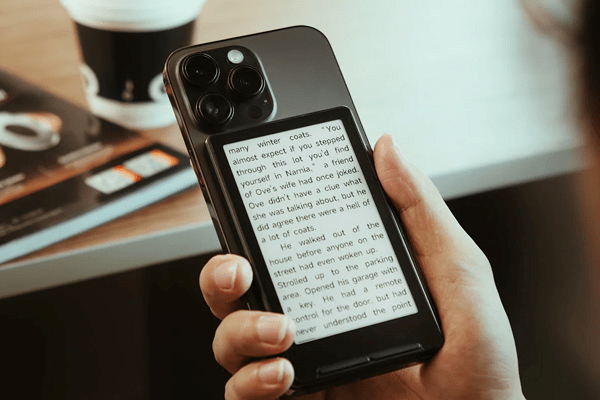
[DigitalToday reporter Jinju Hong (홍진주)] The ultra-compact e-book reader "Xteink X4" draws attention for one reason: it is small. It has a 4.3-inch screen that is smaller than the 5-inch Kobo Mini and smaller than the E-Ink smartphone Boox Palma, making it pocket-sized. At $69 (about 100,000 won), it is among the lowest-priced e-book readers. On Feb. 1 (local time), U.S. IT outlet The Verge listed the Xteink X4's appeal and limitations.
According to The Verge, the X4 feels even smaller than its dimensions suggest. Thin bezels make it highly portable, and it is less than 6 mm thick. Using the included magnetic folio case, it can be carried easily in a sling bag or small bag.
But the evaluation said the device fell short in the functions it had been expected to offer. The X4 highlights an accessory-like form to be used magnetically attached to an iPhone, but on some models including the iPhone 16 Pro, the magnet alignment does not match and it does not stay in place properly. Xteink provides a magnetic auxiliary adhesive ring to address this, but the device's size makes even that less effective. In the end, it is more realistic to use the X4 as a tiny standalone e-book reader.
Its low price comes with clear hardware limits. The resolution is 220 ppi, lower than recent Kindle and Kobo devices at 300 ppi, and it has no screen light, requiring a separate light in dark environments. The lack of a touchscreen also greatly reduces usability. Button control is possible, but the function layout is not intuitive, and some buttons use a two-sided input method that takes time to get used to.
It is also limited on content. It supports TXT and EPUB files and some image formats, but has no built-in store or DRM content support. File transfer is also inconvenient, and the most reliable method is copying files directly to a microSD card. But the card slot is deep, making insertion and removal difficult.
Even so, The Verge said the basic reading experience itself is not bad. Physical page-turn buttons are a strength, and text readability is adequate for everyday reading. But options for font size and line spacing are limited, and images or illustrations are not displayed.
Another point of interest is the user community. Xteink is continuously providing software updates, and installing an open-source alternative firmware called "CrossPoint Reader" simplifies the UI and improves formatting options and button visibility. Installation and restoration are also relatively simple.
The Verge said, "It is hard to recommend the X4 as a main e-book reader," adding, "But for users looking for a tiny E-Ink device they can always carry, it can be a unique alternative they can pull out instead of a smartphone. In particular, the potential for improvement through the community is this small device's biggest appeal."
 Jinju Hong
hongjj@d-today.co.kr
Jinju Hong
hongjj@d-today.co.kr