
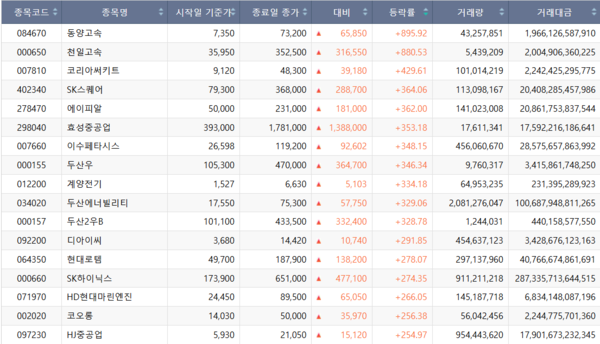
[Digital Today reporter Sangyeop Oh] South Korea's stock market enjoyed a boom this year, with the KOSPI breaking above 4,000 as leading semiconductor shares surged. But a different group of stocks delivered the highest returns for investors. Express bus-related shares surged on the back of a major positive catalyst: redevelopment of the Seoul Express Bus Terminal site in Banpo-dong, Seocho-gu, Seoul.
On Dec. 31, the Korea Exchange said the top-returning stock on the 2025 KOSPI was Dongyang Express. Its share price ended trading the previous day at 73,200 won, up from 7,350 won at the start of the year, a jump of 895.92 percent. Chunil Express, the second-ranked stock, rose 880.53 percent over the same period, closing at 352,500 won from 35,950 won.
The surge in these shares gathered pace from last month. The Seoul city government said on Nov. 26 it began preliminary negotiations with Shinsegae Central City and the Seoul Express Bus Terminal on a mixed-use development of the terminal site of about 146,000 square metres. Investor sentiment heated up after reports said the plan would transform the site into a landmark facility of at least 60 floors.
After the news emerged, both stocks posted the rare feat of hitting their daily upper limit for 9 consecutive trading sessions, undeterred by being designated as high-risk and by trading halts. Chunil Express drew attention as the second-largest shareholder with a 16.67 percent stake in the bus terminal. Dongyang Express, while holding only 0.17 percent, saw buying concentrated as it was grouped as a theme stock.
On the KOSDAQ, semiconductor equipment firm Wonik Holdings ranked first by a wide margin. Its shares surged from 2,550 won at the start of the year to 48,700 won within a year, posting a gain of 1,809.80 percent.
That amounts to an 18-fold jump, beyond a so-called ten-bagger. It is seen as driven by expectations of improving results at subsidiaries Wonik IPS and Wonik QnC, and by a growth outlook for its industrial-robot subsidiary.
Next, Seers Technology, which rode the artificial intelligence (AI) semiconductor theme, rose 1,137.87 percent, and robot mobility specialist Robotechs climbed 1,052.78 percent, placing them among the top KOSDAQ gainers.
The number of so-called "emperor stocks" with a share price above 1 million won rose to 4 from 1 last year. Hyosung Heavy Industries (1,781,000 won), Samsung Biologics (1,695,000 won), Korea Zinc (1,316,000 won) and Samyang Foods (1,231,000 won) made the list.
Hanwha Aerospace, Doosan and Taekwang Industrial also briefly topped 1 million won, but gave up their emperor stock status after a late-year pullback.
The drivers behind each emperor stock differed. Hyosung Heavy Industries jumped 338.13 percent, benefiting from expanded power infrastructure investment as AI spreads. Samsung Biologics rose 81.48 percent as it was reshaped into a pure contract development and manufacturing organisation (CDMO) after a corporate split, boosting expectations for stronger order competitiveness.
Samyang Foods rose 484.80 percent over two years and 66.58 percent this year alone, helped by a global K-food boom led by its "Buldak Bokkeum Myeon". Korea Zinc rose 37.51 percent as the stability of its non-ferrous metals business coincided with China-related issues over controls on exports of critical minerals, keeping its emperor stock status for a second straight year.
South Korean stocks also posted record gains this year on the back of a "semiconductor supercycle". The KOSPI index ended the previous day at 4,214.17, up 75.63 percent from 2,399.49 at the start of the year. That was the highest rise among stock markets in Group of 20 (G20) and Organisation for Economic Co-operation and Development (OECD) member countries.
The performance of Samsung Electronics and SK Hynix, the No. 1 and No. 2 stocks by market capitalisation, was decisive. Samsung Electronics ended the year at 119,900 won, up 125.38 percent from the start of the year, while SK Hynix finished at 651,000 won, up 274.35 percent. Both set record closing highs, driving the index higher.
A financial investment industry official advised, "This year’s market was polarised, with large-cap semiconductor shares lifting the index and theme stocks with individual catalysts generating explosive returns," adding, "In particular, stocks showing short-term overheating such as express bus-related shares can lead to big losses if investors chase them without an earnings basis."
 Sangyeop Oh
yub@d-today.co.kr
Sangyeop Oh
yub@d-today.co.kr