
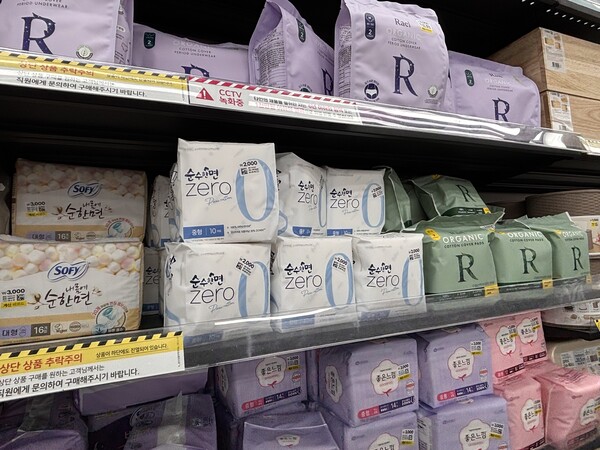
Daiso is preparing to launch a "10-pack 1,000 won sanitary pad" product in May with household goods maker Kkekkeunhanara. The 1,000 won sanitary pads would be priced up to about 60 percent lower than sanitary pads currently sold by Daiso online and offline. Some analysts say Daiso is moving beyond low prices to expand into ultra-low pricing.
On March 5, industry sources said Daiso plans to launch the "10-pack 1,000 won sanitary pads" in May through a collaboration with Kkekkeunhanara. The product would cost about 100 won per pad, an ultra-low-priced item cheaper than existing products sold at Daiso. If the 100 won-per-pad product is launched, prices would fall by up to 60 percent from current selling prices.
Prices for products currently sold through Daiso online and offline channels include 2,000 won for a 16-pack, 3,000 won for a 12-pack and 3,000 won for a 7-pack. Brands on sale include, in addition to Kkekkeunhanara, Yuhan-Kimberly (Good Feel), Sofy, Yeji Mijin and Rael.
Kkekkeunhanara's sanitary pad brand sold at Daiso is "Sunsuhanmyeon", but it has not been disclosed whether the product to be launched in May will also be Sunsuhanmyeon. The company said Kkekkeunhanara will supply the product, produced 100 percent domestically in South Korea.
Daiso said the product was planned to help stabilise prices and support the household economy.
The company expects the product to be useful for consumers who cannot afford bulk purchases of higher-priced sanitary pads. Sanitary pads generally have a structure in which the per-unit price falls with bulk purchases. It also expects accessibility for sales to improve because consumers can buy the product in urgent situations.
Daiso also donated 5,000 packs of sanitary pads to non-governmental organisation Good Neighbors on March 5 to support female adolescents in vulnerable groups. The move is interpreted as aligning with the government's stance to ease the burden of sanitary pad prices. President Lee Jae-myung (이재명) earlier this year pointed out that sanitary pads, essential hygiene products for women, were being sold at high prices.
Beauty and camping goods emerge as the spearhead of an ultra-low-price strategy for higher-priced products.
Daiso has grown by building price competitiveness with low-priced fixed-price products across various categories such as household goods, kitchenware and beauty products. It offers products in the 1,000 to 5,000 won range.
Daiso has grown into a company with annual sales of about 4 trillion won. Daiso's annual sales were 2.4216 trillion won in 2020, 2.6048 trillion won in 2021, 2.9458 trillion won in 2022, 3.4605 trillion won in 2023 and 3.9689 trillion won in 2024, according to the Financial Supervisory Service's electronic disclosure system. Sales grew 62.9 percent over five years. With 2024 sales falling just short of 4 trillion won by a narrow margin, the company is likely to exceed the mid-4 trillion won range this year.
Daiso's steep growth in scale is analysed as being largely driven by its recent expansion into higher-priced categories such as beauty and camping goods. It is an ultra-low price strategy that aligns the price range of those categories, which have relatively high market prices, with Daiso's pricing. Industry sources said Daiso's beauty category sales grew 85 percent in 2023, 144 percent in 2024 and 70 percent last year.
As of the morning of March 5, camping goods and beauty products ranked 1st and 5th to 6th, respectively, in the daily top 10 sales of all items on the online Daiso Mall. In the first week of March, beauty products occupied 5th, 8th, 12th, 13th, 14th, 15th and 16th places in the weekly top 20 sales list.
If the 1,000 won sanitary pads set for launch in May join the lineup, Daiso's ultra-low-price strategy is expected to be strengthened.
Will strong interest make it a sellout item? Focus on Daiso's ability to manage supply.
Industry sources said Kkekkeunhanara will proceed with certification procedures from the Ministry of Food and Drug Safety before the May launch. Under relevant laws, the product can be sold once safety tests and standards are met, including detailed specifications and standards suited to 1,000 won sanitary pads.
However, the final specifications and standards for the Daiso-exclusive 1,000 won sanitary pads have not been finalised. Daiso and Kkekkeunhanara are currently discussing details.
Kkekkeunhanara said the sanitary pad products sold at Daiso have the same product specifications as those sold through other channels. Differences are in the composition, such as the number of items included or the packaging format. For the 1,000 won sanitary pads, basic specifications such as absorbency, leak prevention and skin safety will be applied the same as existing Kkekkeunhanara products.
A Kkekkeunhanara official said, "The sanitary pads scheduled to be launched in May were developed in collaboration with Daiso to contribute to price stabilisation, and are a model reflecting the channel's pricing policy and operating strategy." The official added, "Details such as product specifications will be disclosed at the time of launch."
After the launch, Daiso's management capability is expected to be tested again. With frequent sellouts of popular and new items, the 1,000 won sanitary pads are also expected to become a sellout item. Recently, several products have emerged as Daiso sellout items, including Malang Fit storage containers, vacuum storage containers and vacuum compressors, and Reedle Shot.
Some also raise concerns that if the 1,000 won sanitary pads become a Daiso sellout item, it could make it difficult for vulnerable groups, cited as beneficiaries of the product launch, to purchase them. Daiso said it plans to sell the product on a regular basis and manage inventory.
A Daiso official said, "We plan to sell the product on an ongoing basis in line with our existing operating direction of providing it at a reasonable price even if margins are not large."
 Shin-hye Ahn
doubletap@d-today.co.kr
Shin-hye Ahn
doubletap@d-today.co.kr