
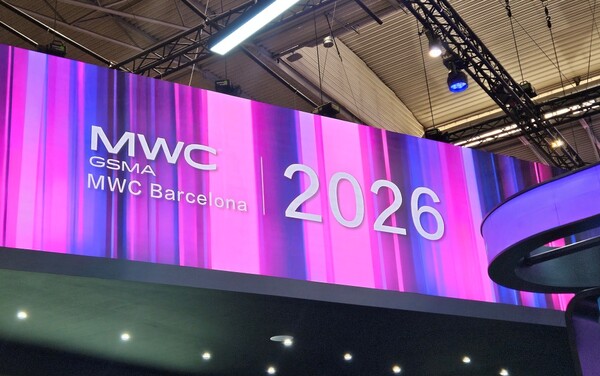
[Barcelona, Spain = Digital Today reporter Jin-ho Lee] Mobile World Congress (MWC) 2026, the world’s largest mobile telecoms exhibition, wrapped up on March 5 (local time) after four days. This year’s MWC was a venue to confirm the telecom industry’s technology direction centered on artificial intelligence (AI), beyond mobile technology. With China’s presence standing out, a range of technology trends, including next-generation technologies preparing for the 6G era, satellite networks and AI-based devices, filled Barcelona, Spain.
South Korea’s three mobile carriers step up race to become 'AI companies'
South Korea’s three mobile carriers stepped up moves to become 'AI companies' at the event. While they have been at the stage of mapping out AI business visions, this year is expected to be the first year of commercialisation moves.
SK Telecom put a 'full-stack AI' strategy to the fore that links AI infrastructure, models and services. It aims to secure competitiveness by building a structure that runs from AI data centres (AI DC) and large language models (LLM) through to services. During the event, SKT demonstrated its in-house AI model, 'A.X (A-dot) K-1', to highlight its competitiveness. A-dot K-1 is designed to process various data such as text and images at a scale of 519B (519 billion parameters). SKT is speeding up its market push with an AI model optimisation strategy tailored to various domains, including industrial sites.
KT stressed a platform strategy targeting the corporate AI transformation (AX) market. At the event, KT unveiled its enterprise AI operating system (OS), 'Agentic Fabric'. It is a platform designed to automate corporate work based on AI agents and to manage various systems in an integrated way. KT explained that AI agents can boost corporate productivity and work efficiency. It will also expand AI services for corporate customers by combining AI network technology with cloud infrastructure. It aims to expand the business-to-business (B2B) market based on references secured in public and corporate fields, including AI to support court trials and an education platform.
LG Uplus presented a voice-based AI service strategy centred on its AI agent, 'ixi-O'. Ixi-O is an AI call agent that understands conversational context based on voice data and links various services. The LG Uplus booth drew attention by demonstrating services combining robots and AI agents. It showcased a humanoid robot understanding users' voice commands and performing actions, expressing its ambition to lead the 'physical AI' era. LG Uplus plans to expand its software business based on voice AI technology and push into global markets in cooperation with overseas operators.
Samsung Electronics also put forward its 'Galaxy AI' strategy at MWC26 and presented the direction for expanding its mobile ecosystem. Samsung Electronics showcased voice and image-based AI functions and tailored user experiences centred on the Galaxy S26 series. It also unveiled telecoms infrastructure technologies such as AI-based virtualised networks and 5G private network solutions, stressing AI competitiveness across mobile and networks.
China firms mount major offensive, drawing attention with large booths and new products
Chinese companies showed a notable presence at this year’s MWC. Along with equipment companies such as Huawei, Xiaomi and Honor, the activities of telecoms carriers such as China Telecom also stood out.
Huawei unveiled AI-based network technology and next-generation telecoms equipment. It also drew attention by presenting a technology roadmap that runs from 5G-Advanced to 6G. At a large booth spanning 1,200 square metres, Huawei introduced wired and wireless communications technology, as well as AI devices including the latest smartphones and wearables and robots. Visitors seeking consultations continued to visit the B2B exhibition zone, including intelligent mobile transport technology and power solutions.
Xiaomi unveiled its new smartphone, 'Xiaomi 17', through a global launch event the day before MWC26 opened. In particular, the 'Xiaomi 17 Ultra' drew attention for a high-performance camera developed in collaboration with Leica. It also displayed the Electric Scooter 6 series, the full lineup of Mijia smart home appliances and its electric car, the 'Xiaomi SU7 Ultra'. Xiaomi also unveiled an electric hypercar concept model, 'Xiaomi Vision Gran Turismo', showing its intent to take the lead in the future mobility market.
Chinese smartphone makers also unveiled new products with strengthened AI features. Honor, a smart device brand spun off from Huawei, ran demos of a robot phone and a humanoid robot. The robot phone, which applied a 200MP camera in the form of a robot arm to the top of the smartphone, drew strong interest at the exhibition hall.
Chinese carriers strengthened coordinated moves. China Mobile, China Telecom and China Unicom, the country’s three major carriers, highlighted their presence by launching a 'Mobile AI Innovation Initiative' with the GSMA, which hosts MWC.
6G and AI network talks broaden as 'smart glasses' emerge as a key topic
The MWC also saw active discussions on next-generation network technologies and ways of operating AI networks. Global telecoms equipment companies unveiled technologies that automatically operate and optimise networks using AI.
The shift to 6G was also a key topic. Global carriers and equipment companies are conducting 6G research and development with a goal of commercialisation around 2030. Qualcomm CEO Cristiano Amon presented evolution to the 6G era as a key element underpinning the AI era in a keynote speech. "6G networks will evolve into computing systems and become core infrastructure for various industries," Amon said.
New forms of AI devices were also a topic. Camera technology that automatically assists shooting using AI functions and AI tablets applying high refresh-rate displays drew interest. Smart glasses, in particular, are expected to become a 'game-changer' that increases uplink traffic along with high convenience.
Smart glasses can increase demand for data uplinks and help spread next-generation telecoms standards such as 5G-Advanced and 6G. As smart glasses spread, demand for related solutions from telecoms equipment companies and graphics processing unit (GPU) companies is expected to increase. Smart glasses introduced by Meta and others at this year’s MWC saw continued hands-on experiences by visitors. An industry official said the success of smart glasses could act as an important variable in the spread of next-generation telecoms standards.
Non-terrestrial network (NTN) technology, including satellite communications, also drew attention. NTN, which enables communications in oceans or remote areas where it is difficult to install base stations, was cited as one of the key future technologies as commercialisation speeds up. Coinciding with the event, the United States and Israel bombed Iran, adding to interest in NTN.
MWC is the world’s largest mobile industry exhibition held every year in Barcelona, Spain. Telecoms, AI, semiconductor and device companies participate to share technology trends. There is an assessment that AI and 6G became the key themes of MWC26 this year.
 Jin-ho Lee
jhlee26@d-today.co.kr
Jin-ho Lee
jhlee26@d-today.co.kr