
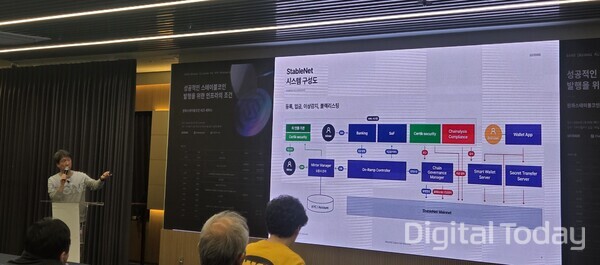
Wemade unveiled detailed technical specifications for its in-house mainnet, Stablenet, designed to improve the complex user experience of existing blockchains. It is targeting entry into the real-world financial market by addressing the dual burden of having to hold a separate coin for gas fees and privacy violations caused by excessive transparency.
Son Woo-sang (손우상), head of Wemade's mainnet development team, said at a won stablecoin tech seminar at the Oakwood Hotel in Seoul's Gangnam district on Jan. 29 that he had spent 8 years using blockchain while thinking about why it was not applied to real life. He said he ultimately concluded that building a dedicated chain for the company's own stablecoin was the most reasonable approach.
“Email hacked... existing chains unsuitable for payments”
Son cited inconvenient user experience and traits ill-suited to corporate payments as reasons blockchain has not been applied to real life.
He said volatile assets such as Ethereum face strong resistance as a means of payment, and that even when using a stablecoin such as USDC there is a burden of having to hold a separate coin to pay fees, or gas. He also said a critical problem with public chains that disclose all transaction histories is that if a company pays salaries, individual employees' annual pay would be exposed on-chain.
He also described the difficulty of managing private keys, citing his own experience. Son said he had been hacked after his email account was compromised even though he stored his private key encrypted in email, adding that it is too burdensome for ordinary people to manage and that the chain itself cannot respond to hacking.
He said existing private chains or layer-2 solutions are also difficult to use as alternatives. Private chains are closed to external connections, while L2 solutions either inherit Ethereum's slow speed or face structural limits in which operators must bear ongoing costs to cover gas fees through paymasters, he said.
3,000 TPS, 1-second finality... fees solved with a 'single coin'
Wemade built Stablenet, its own layer-1 mainnet, to address these issues. It forked Hyperledger Besu-based QBFT and applied its self-developed WBFT consensus algorithm, designed to generate blocks and finalise transactions within 1 second.
Son said recent performance tests showed 3,000 transactions per second, and that there is room to increase it further by focusing on performance tuning. He said fast transactions are possible because one block is finalised every second with a 1-second block time.
A key feature is the 'native coin adapter' technology. Stablenet's base currency, 'WKRC (tentative name)', is a stablecoin that also serves as the fee token. Son said users can transfer and make payments using only the stablecoin without having to buy a separate gas coin, and that it supports an ERC-20 interface based on Circle's stablecoin token standard version 2.2 to secure external interoperability.
It also added safeguards. It implemented not only an emergency stop but also a flow to recover assets after freezing them. Son said USDC has an emergency stop function but no post-freeze procedure, adding that Stablenet provides a channel for voluntary recovery and, if that fails, a function for forced recovery.
Key authorities were distributed through governance contracts. Roles were divided into chain upgrades (governance validators), coin issuance and burning (governance minters), minter registration and deletion (master minter), and blacklist registration (governance council). Validators adopted a model to generate revenue through a fee of about 1 won per transaction. Son added that there is sufficient business potential once the chain becomes active.
‘Auditable secret transfers’ implemented... dedicated wallet to be unveiled in February
As a way to address both anonymity and regulatory compliance, which are central to financial transactions, the company introduced a 'secret account' and a dedicated wallet. This applies stealth address technology under the ERC-5564 standard and, together with EIP-7702, implements automatic transfers and fee sponsorship functions.
Son said a model in which recipients continuously generate one-time addresses is difficult to manage, but Stablenet automated it through a 'transfer server'. He said it enables corporate salary transfers and secret transfers because it is not possible on the blockchain to know who sent how much to whom.
It also added a mechanism to respond to regulation. Because the transfer server holds mapping information, it can be submitted if regulators or audit institutions request the ledger. Son said financial transactions require transparency but traders also need privacy, adding that a fully open environment like an existing public blockchain is not suitable.
The new dedicated wallet is expected to be unveiled in February. Kim Seok-hwan (김석환), a Wemade vice president, said in a morning presentation that wallet development was well advanced and that it would be distributed to partner companies after the Lunar New Year holiday period.
“Forced recovery on the mainnet in case of a bridge incident”
In the Q&A session, questions focused largely on security. Son said the company adopted Chainlink's CCIP (Cross-Chain Interoperability Protocol) to enhance security.
Kim said Chainlink is a global top-tier solution with a record of incident-free integrity, and that major players such as JPMorgan use it, stressing its reliability. Ahn Yong-woon (안용운), Wemade's CTO, added that even if an incident occurs on a bridge, the system was designed to detect abnormal transactions at the mainnet level to freeze assets or force recovery, blocking damage at the source.
On competitiveness against rival chains, Kim said the company is the only one in South Korea that has moved beyond proof-of-concept to launch a testnet and implement concrete technology. He said the company would lead the market with real technology, not at the light paper stage.
Concluding his presentation, Son said the past had seen many side effects because anyone could build blockchain services, but that going forward blockchain must become “value-centred” and easy for users while complying with regulation.
 Lee Ho-jung
lhj@d-today.co.kr
Lee Ho-jung
lhj@d-today.co.kr