
South Korea's Democratic Party digital assets task force has pledged to submit a "Digital Assets Framework Act" before the Lunar New Year holiday, but disagreements between the party and the government over key issues persist, suggesting a difficult path ahead.
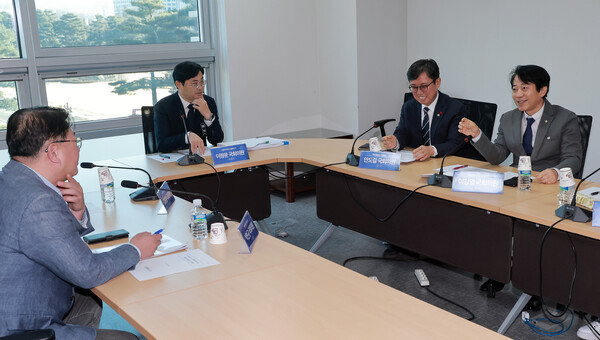
Political and financial circles said on Jan. 28 that the party's digital assets task force held a closed-door meeting that day to discuss the legislative direction. The task force agreed to submit the framework act before the Lunar New Year holiday, but it was confirmed that it remains at odds with government authorities over the details.
Opinions are split even within the party over sensitive issues that could reshape the market, including a bank 51 percent stake rule for stablecoin issuers and limits on major shareholders' stakes in exchanges.
The sharpest standoff is over the issuance structure for a won stablecoin.
The Financial Services Commission is maintaining its position that banks must be required to hold at least a 51 percent stake in an issuance consortium to ensure a stablecoin's credibility and stability. It argues that banks' capital strength and oversight are essential to prevent system risk like the Terra-Luna incident.
Related industries and some lawmakers, however, are pushing back. They say if banks hold a majority stake, no new business would be possible without banks' approval, raising concerns fintech firms could be reduced to subcontractors.
Legal contradictions are also an obstacle. Article 37 of the current Banking Act limits banks, under the separation of industry and finance principle, from owning more than 15 percent of voting shares in non-financial companies.
Digital assets are also not recognised as financial investment products under the Capital Markets Act. If digital assets are not financial products but a won stablecoin issuer is designated as a financial company, it creates a contradiction in which a financial firm handles non-financial products.
Financial authorities are also said to recognise the issue and be weighing realistic supplementary measures.
Democratic Party lawmaker Lee Kang-il (이강일) said, "Positions on both sides are very sharp," adding, "We did not reach enough of an agreement today to speak in detail," signalling hurdles ahead.
Overhauling the governance structure of digital asset exchanges is another flashpoint.
Financial authorities define digital asset exchanges as public infrastructure and are pushing a plan to cap major shareholders' stakes at around 10 to 15 percent to prevent unilateral management by a specific controlling shareholder.
Financial Services Commission Chairman Lee Eok-won (이억원) said at a monthly briefing for reporters covering the commission that day, "We will push a plan to limit ownership stakes so that control is not concentrated in a specific shareholder."
If this plan is legislated, major shareholders such as Song Chi-hyung (송치형), chairman of Dunamu, the operator of Upbit, with a stake exceeding 25 percent, and former Bithumb chairman Lee Jung-hoon (이정훈) would have to forcibly sell a significant portion of their holdings.
That is also why Financial Services Commission Vice Chairman Kwon Dae-young (권대영) contacted lawmakers on the National Assembly's Political Affairs Committee on Jan. 27 to strongly request that this provision be included.
Task force head Lee Jung-moon (이정문) took a cautious stance, saying, "There is a consensus on limiting major shareholders' stakes in exchanges, but the party needs additional internal review on legislative strategy, such as whether to include it immediately in this bill." He said the party cannot ignore industry pushback over excessive infringement of property rights and threats to management control.
Kim Jae-jin (김재진), senior vice chairman of the Digital Asset Exchange Alliance, or DAXA, said at another event that day, "If ownership is hastily dispersed, this could become an issue that is neither anyone's responsibility nor anyone's honour," stressing the need for ownership with expertise.
As the situation stands, critics say the goal of submitting the bill before the Lunar New Year holiday is being undercut as conflict between the party and the government deepens. It was also reported that there was no explicit agreement on a bank 51 percent consortium plan during a party-government consultation held on Jan. 1.
An industry official said, "The party and the government speak of national interest and the people, but in reality they are busy calculating their own numbers and are missing the golden time," adding, "I hope the National Assembly and authorities produce a reasonable bill that the industry can accept while not undermining the related industry during the discussion process."
 Sangyeop Oh
yub@d-today.co.kr
Sangyeop Oh
yub@d-today.co.kr