
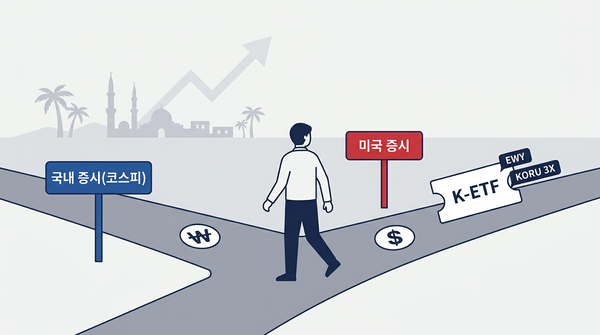
Despite a recent boom in South Korea's stock market, overseas South Korean retail investors appear to be choosing Korea-related exchange-traded funds (ETFs) listed in the U.S. stock market rather than returning. A stronger dollar tied to the recent Middle East situation is also lifting expectations for foreign-exchange gains, raising questions over the effectiveness of government policy.
The KOSPI ended up 490.36 points, or 9.63 percent, at 5,583.90 on Thursday from the previous session, the Korea Exchange said. After a record one-day drop of 12.06 percent a day earlier, strong bargain buying flowed in within a day, recouping a large part of the losses.
As the domestic market swings between sharp falls and surges within a day, the main reason overseas retail investors are hesitating to redirect funds back home is the strong dollar.
The Middle East situation has acted as a source of anxiety for the domestic market and shook the index. In the foreign-exchange market, it has pushed up the value of the dollar as a safe asset, providing U.S. stock investors with a solid buffer of foreign-exchange gains.
With military clashes between the United States and Israel and Iran intensifying, the won-dollar exchange rate has risen sharply. In the Seoul foreign-exchange market on Wednesday, the won closed at 1,476.2 per dollar in daytime trading. In overnight trading, it briefly broke above 1,500, sharply widening volatility in the currency market.
The sharp rise in the exchange rate delivers large foreign-exchange gains to investors holding U.S. stocks. When the won weakens, the won value of dollar assets rises even if stock prices do not change.
As of January 2026, the value of U.S. stocks held in custody by South Korean investors also topped 253 trillion won, a record high, reflecting a mindset of continuing to hold dollars as a hedge against elevated exchange rates.
In this situation, the return investment account (RIA), a key incentive to bring overseas retail investors' money back, has not cleared the National Assembly. A subcommittee meeting of the National Assembly's Strategy and Finance Committee that was scheduled for Feb. 27 was cancelled, indefinitely postponing discussion of a related revision to the Restriction of Special Taxation Act.
The RIA is a system that offers up to a 100 percent capital gains tax cut if proceeds from selling overseas stocks are invested for the long term in domestic stocks. The Ministry of Finance and Economy originally planned to pass the bill in the February extraordinary session and launch the accounts immediately within the first quarter.
However, the bill, introduced as a lawmaker-sponsored initiative in mid-January, remains pending. A prevailing view is that passage at a plenary session will be pushed back to after the end of March.
If legislation slips into the second quarter, the period in which investors can actually receive benefits until the application deadline of Dec. 31, 2026 would shrink to around six months.
As a result, the Korea Financial Investment Association has recommended that securities firms refrain from advance promotional marketing. Promotion strategies that brokerages had prepared are also on hold.
While the launch has been delayed, the KOSPI has also staged a record rally. On the 25th of last month, the KOSPI index reached 6,022.70, breaking above 6,000 for the first time.
But overseas retail investors chose a way to invest in gains in South Korea's stock market through the U.S. market while keeping dollars, instead of directly buying domestic shares in won.
Among the main products that drew demand were iShares MSCI South Korea (EWY) and Direxion Daily MSCI South Korea Bull 3X Shares (KORU). KORU is a leveraged product that tracks the MSCI Korea index at three times leverage, and it posted a 1-year return of 863.65 percent, far outpacing the return of the Nasdaq 100 (QQQ).
In the last week of February, South Korean investors net bought 73,857,900,000 won ($51,329,420) worth of KORU and 51.7 billion won worth of EWY. As of March 4 local time, investors in the top 1 percent of brokerage-account returns also appeared to have accumulated these stocks heavily.
The appeal of the exchange rate and leverage, more than tax benefits, is a major reason investors stick to the indirect approach. When overseas-listed ETFs are traded through U.S. stock accounts, a 22 percent capital gains tax is imposed on profits exceeding 2.5 million won a year.
Direct investment in domestic stocks, in contrast, comes with a capital gains tax exemption. Even so, overseas retail investors are adopting a strategy of accepting tax payments while pursuing profit opportunities in a volatile Korean market and foreign-exchange gains from a strong dollar at the same time.
The financial investment industry assesses that the incentive effect of the policy has weakened as the gap has widened between the timing of the system's introduction and market conditions. Compared with when policy discussions began, the KOSPI has already surged sharply, meaning investors have missed the chance to buy at low prices through the RIA.
Young-gon Lee (이영곤), head of the research center at Toss Securities, said, "Without a recovery of structural trust in the domestic market, it is difficult to bring investors back with tax benefits alone." He added, "Money always flows to where higher returns are expected, so the key is restoring trust that the domestic market is truly a place 'worth investing' in."
 Sang-yeop Oh
yub@d-today.co.kr
Sang-yeop Oh
yub@d-today.co.kr