
[DigitalToday reporter Jinju Hong (홍진주)] No Galaxy smartphone equipped with a solid-state battery has appeared yet. Solid-state batteries once looked close to commercialisation, but why have they not been applied to smartphones? On Jan. 27 (local time), IT outlet PhoneArena reviewed Samsung’s solid-state battery development status and when it could be used in Galaxy devices.
The first signs that Samsung was considering solid-state batteries for smartphones emerged in 2017. At the time, the Korea Herald cited remarks by a Samsung SDI executive as saying production technology for solid-state batteries for smartphones would reach a mature stage within 1 to 2 years. It added that whether they would actually be used in smartphones depended on Samsung Electronics’ decision.
Samsung SDI, which covers energy storage systems (ESS) and renewable energy, has continued solid-state battery research for more than 10 years. But there was no notable progress for several years on using the batteries in smartphones. Expectations also rose at one point that the Galaxy Note10 would include a solid-state battery, but it did not happen.
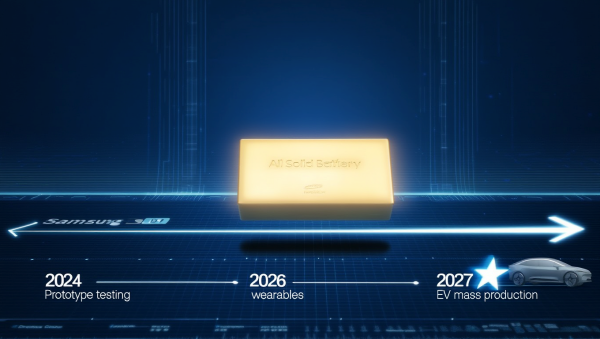
The next clue came through a Samsung Electro-Mechanics press release on Sept. 22, 2024. Samsung Electro-Mechanics officially announced it had succeeded in developing what it called the world’s first small solid-state battery that can be applied to wearable devices. Technical details were not disclosed, but the battery can be made in various shapes and its energy density was known to be about 200Wh/kg, the highest level in the industry at the time. Samsung Electro-Mechanics aims to apply the small solid-state battery to wearable devices such as the Galaxy Watch and Galaxy Ring and mass-produce it by the end of 2026.
Donut has now unveiled a solid-state battery of about 400Wh/kg, but it has not revealed specific plans for solid-state batteries for small wearable devices. In that respect, Samsung’s strategy is assessed as a relatively realistic approach.
In smartphone battery technology, silicon-carbon batteries are evolving faster. Silicon-carbon batteries combine silicon with a graphene anode to sharply raise energy density, and can theoretically reach up to 1,300Wh/kg.
China’s Honor is a representative company that has commercialised the technology. Following the Honor Magic5 Pro and Magic6 Pro, its latest model, the Honor Power 2, is equipped with a fourth-generation silicon-carbon battery with a capacity of 10,080 mAh. Its energy density is 821Wh/kg, more than 4 times higher than Samsung’s first-generation solid-state battery. Silicon-carbon batteries still rely on liquid electrolytes and rare metal resources. Solid-state batteries, by contrast, are mainly based on carbon and silicon and are assessed as having strong long-term competitiveness in terms of cost and supply chains.
In the industry, there is speculation that Samsung Electronics could unveil a wearable prototype equipped with a solid-state battery as early as March at MWC 2026 in Barcelona, Spain. The lifespan of first-generation solid-state batteries is similar to existing lithium-ion batteries, but charging speed could be cut to minutes or even seconds.
The possibility of solid-state batteries being applied to the Galaxy S26 series is low, but some forecasts say there could be room for adoption in the Galaxy S27 series if mass production for wearables proceeds smoothly. With Donut already entering mass production of electric motorcycles equipped with solid-state batteries, market competition is expected to accelerate further.
Some are also cautiously raising the possibility that wearables and smartphones equipped with solid-state batteries could appear at the same time as early as the start of 2027. As solid-state battery technology moves into a mature stage, attention is focusing on the direction of next-generation energy storage technology.
 Jinju Hong
hongjj@d-today.co.kr
Jinju Hong
hongjj@d-today.co.kr