
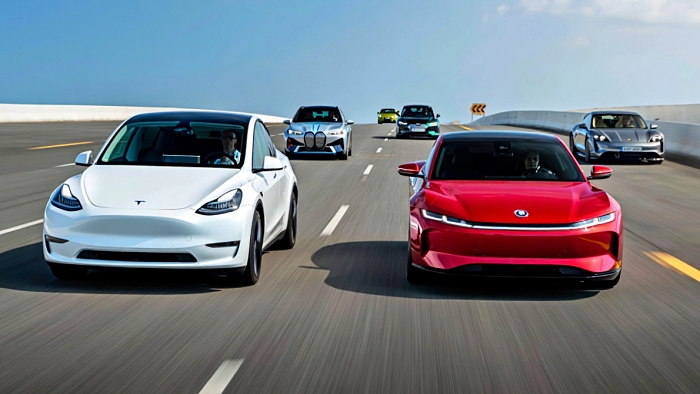
[DigitalToday reporter Hyunwoo Choo (추현우)] Tesla and China’s BYD are rapidly expanding their presence in South Korea’s electric vehicle market.
In the imported car market, EV share has risen steadily to 18 percent in 2024. Last year, Tesla sold about 60,000 EVs, posting a dominant market share. BYD sold 6,107 units, moving into the top ranks in a short period. By contrast, German premium brand BMW sold 5,821 units, Audi sold 4,427 and Porsche sold 3,626, showing relatively weak results.
• Tesla, BYD surge in share of Korea’s imported EV market, while Germany’s top 3 struggle • Can’t buy a new car because of AI? Warning of a 2026 auto chip crisis
As the global AI industry grows rapidly, demand for various semiconductors and memory is surging, putting renewed pressure on the supply of automotive semiconductors. In 2026, DRAM shortages could push prices up 70 to 100 percent. Makers with heavy reliance on electronic systems, including Tesla and Rivian, are expected to be particularly affected.
• Why GM is swimming against the tide: Chevrolet Bolt EV production ends, return to internal-combustion cars • Germany revives EV subsidies, including China-made models • China’s BYD shakes up the global EV market with price and volume
GM is ending production of the Chevrolet Bolt EV at its Kansas plant and switching to internal-combustion vehicles. The shift accelerated as production in the United States is being pursued for the China-made Buick Envista due to President Donald Trump’s tariff policy. GM plans to expand ICE production through restructuring worth $600 million in the future.
Germany has revived its EV subsidy scheme, extending it to range-extended EVs and China-made models. 8,000,000 vehicles are expected to receive the benefit. Subsidies of up to $7,000 will be paid depending on the vehicle type and the buyer’s income. The German government says it expects the EV market to be revitalised and that it will not impose restrictions on China-made models.
Binmyan. BYD has overtaken Tesla to become the world’s largest EV seller, signalling a shift in leadership in the global EV market. BYD’s influence is expected to expand further depending on the possibility of entering the U.S. market and whether it strengthens price competitiveness.
• Tesla removes Autopilot and focuses on expanding FSD subscriptions • Tesla Model Y spotted with ‘AI4.5’ chip, filling the gap as AI5 is delayed • Tesla announces a patent to improve HW3 performance, but full self-driving is ‘still’ not possible • “Autonomous driving is safer than humans” - U.S. insurer halves premiums for Tesla FSD
Tesla has removed Autopilot, which was previously included as standard with Model 3 and Model Y purchases in North America, to steer customers toward FSD (Full Self-Driving) subscriptions. To use Autopilot, including lane-keeping, users must subscribe to FSD for $99 a month.
Tesla is quietly shipping Model Y vehicles fitted with AI4.5 hardware to address delays in the launch of its next-generation AI5 chip. AI4.5 appears to have improved performance versus AI4. It has 3 SoCs to boost computing power. It is expected to serve as a stopgap until AI5 is released.
Tesla has disclosed a patent to improve the performance of its HW3 self-driving computer. But full self-driving remains impossible due to memory limitations and camera performance issues. HW3 owners are expected to receive only a limited-function “V14 Lite” version.
A U.S. insurer has launched an “autonomous vehicle insurance” product that offers Tesla FSD users a 50 percent premium discount. Based on data showing lower accident rates for vehicles equipped with FSD, premiums are set at about half the level per mile driven.
• CATL mass-produces commercial sodium-ion batteries as lithium alternative rises • China’s Geely produces its first solid electrolyte battery, accelerating EV technology innovation
CATL has started producing commercial sodium-ion batteries, unveiling battery technology that delivers strong performance even in low temperatures. Sodium-ion batteries are expected to become an important alternative for energy storage and for today’s lithium-battery-based EV market.
Geely will complete production of its first solid electrolyte battery in 2026, joining the next-generation EV battery race in earnest. The new battery has about 15 percent higher energy density than existing lithium-ion batteries, with improved safety and efficiency. It plans verification tests on existing EV platforms.
• Elon Musk: Optimus robot production will be extremely slow at first • Autonomous driving chooses farms and mines over roads, speeding up commercialisation
Elon Musk said production of Tesla’s Cybercab robotaxi and Optimus robot will be “so slow it will feel painful” at first. The Cybercab is scheduled to be launched in April. The Optimus robot targets production by the end of 2026.
Commercialisation of autonomous driving technology is accelerating not on public roads but on farms and at construction sites. With progress in urban autonomous driving slowed by regulation and safety issues, controlled environments with fewer pedestrians and unexpected variables are emerging as a new market.
• Honda unveils 110cc-class electric scooter ‘UC3’, targeting the Vietnam market
Honda is launching the UC3 electric scooter aimed at the Southeast Asian market, stepping up efforts to replace gasoline scooters. The UC3 features Honda’s first fixed LFP battery, offering a maximum range of 122 km and a top speed of 80 km/h.
 Hyunwoo Choo
cookinpapa@d-today.co.kr
Hyunwoo Choo
cookinpapa@d-today.co.kr