
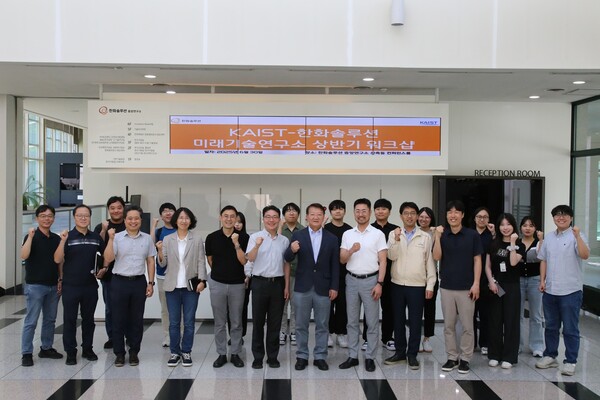
KAIST and Hanwha Solutions said on Jan. 23 they filed a total of 34 patent applications through industry-academia research cooperation. They said the results helped the KAIST-Hanwha Solutions Institute of Future Technology secure competitiveness in next-generation petrochemical core technologies focused on energy efficiency and environmental sustainability.
Earlier, the two sides signed a business agreement in November 2015. The two institutions agreed to cooperate with the goal of securing core technologies linked to mid- to long-term industry strategies, beyond short-term, results-focused industry-academia cooperation. The agreement was named "KAIST-Hanwha Chemical Future Technology Development".
Based on this, the KAIST-Hanwha Solutions Institute of Future Technology was established in 2016. Research areas include core technologies for next-generation petrochemical materials, energy-saving high-purity refining processes, catalysts for carbon dioxide capture and hydrogen production, and production of bio-based feedstocks.
The institute focused on researching key technology groups that can be applied across industry. It said it secured multiple core technologies with commercialization potential and technological scalability by filing a total of 34 patent applications. The achievements are assessed as having laid the technological foundation to respond to structural changes in the global petrochemical industry, such as reducing energy costs, cutting carbon and shifting to environmentally friendly practices.
KAIST plans to build a long-term and sustainable industry-academia research network through follow-up research cooperation with Hanwha Solutions.
Kim Jeong-dae (김정대), head of Hanwha Solutions' research institute, said, "Cooperation between Hanwha Solutions and KAIST is an exemplary case that created academic value and industrial value at the same time." He said, "The results accumulated through this project will serve as a foundation for strengthening the competitiveness of South Korea's petrochemical industry in the global market."
Lee Sang-yup (이상엽), KAIST vice president for research and head of the institute, said, "This cooperation is a case that shows long-term, investment-based industry-academia cooperation can lead to actual industrial competitiveness." He said, "KAIST will continue to focus on core technologies and talent development that will lead future industries."
 Dae-geon Seok
d2dg@d-today.co.kr
Dae-geon Seok
d2dg@d-today.co.kr