
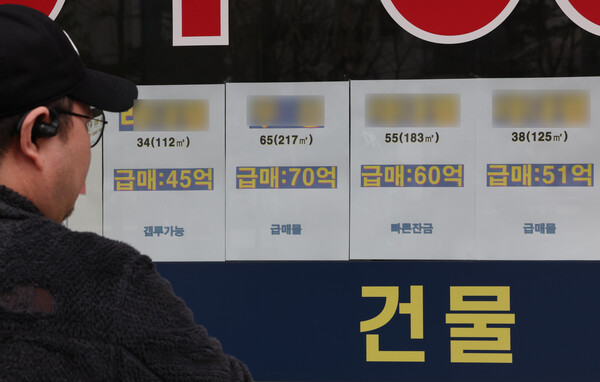
As financial authorities move to overhaul the practice of extending loans for multi-homeowners, the possibility is being raised that the scope of regulation could expand to non-resident single-homeowners. With the president directly signalling pressure on investment and speculative single-homeownership, additional measures across finance and taxation appear inevitable.
According to the financial sector on March 5, the Financial Services Commission held its fourth inspection meeting on March 3, chaired by Vice Chairman Kwon Dae-young (권대영), to improve the practice of extending loans for multi-homeowners. Financial authorities have begun work on designing specific regulations by conducting a comprehensive review across the financial industry and compiling detailed statistics such as outstanding mortgage balances by number of homes owned, balances by lien ranking, remaining maturities, and amounts maturing in the first and second halves of 2026 by housing type and region.
The recent focus of discussions has been on multi-homeowners and rental business operators in the Seoul metropolitan area and other regulated zones. A leading option under review is to apply a 0 percent loan-to-value ratio standard to extensions of existing loans, the same as for new loans, effectively inducing full repayment. That means treating maturity extensions as new loans and applying the same level of regulation.
The scope widened after public remarks by President Lee Jae-myung (이재명). In a post on X, formerly Twitter, Lee wrote: "We will mobilise all policy tools to create a situation where it is more advantageous for not only multi-homeowners but also single-homeowners who hold homes for investment or speculation rather than for residential purposes to sell rather than hold." He also wrote: "Ultra-high-priced homes will bear burdens and regulations commensurate with the level of capital cities in advanced countries."
He added: "Various regulations and burdens will be based on a single home for actual residence, but we will apply weights in a detailed way depending on whether it is for residence, the number of homes, the price level of the home, and regional characteristics."
Financial authorities are therefore discussing a plan to expand restrictions on extending loan maturities for multi-homeowners to non-resident single-homeowners. Another option being mentioned is to further reduce limits, following last year’s Sept. 7 measures that capped jeonse loan limits for single-homeowners at 200 million won and the Oct. 15 measures that applied the debt service ratio (DSR).
This would extend regulations introduced to block gap investment to non-resident owners of high-priced single homes. Within and outside the financial sector, some have also raised the possibility that a new procedure could be introduced to separately verify non-resident status at the loan screening stage. The Financial Supervisory Service is reported to have reviewed loan conditions for apartments in regulated zones held by non-resident rental business operators.
Banks and financial groups are also likely to face a parallel push on prudential rules. The FSC raised mortgage loan risk-weighted assets (RWA) to 20 percent from 15 percent starting this year, and is reviewing an additional increase to 25 percent.
If the risk weight rises by 5 percentage points, banks would have to set aside more capital for the same amount of lending, producing an effect of shrinking loan supply. As a result, analysis suggests assessments of borrowers’ repayment capacity would inevitably become even stricter.
On taxation, the market is discussing the possibility of strengthening holding taxes through adjustments to the public price realisation rate and re-raising the fair market value ratio. Whether to adjust the capital gains tax exemption threshold for single-homeowners, currently 1.2 billion won, is also being cited as a topic for discussion.
However, given the average transaction price of apartments in Seoul stood at 1,521,620,000 won as of January this year, there are also concerns that lowering the exemption threshold could bring all of Seoul into the tax impact zone. Analysis suggests it could create market confusion by imposing taxes even on ordinary single-homeowners. For that reason, it also cannot be ruled out that a differentiated approach by price bracket could be pursued in parallel to minimise market shock.
The industry points out that unless criteria for determining "non-resident" and "speculative purpose" are designed with precision, market distortions and tax resistance could occur. Financial authorities plan to gather on-the-ground views from banks to establish criteria for distinguishing between speculative and owner-occupier loans. Against that backdrop, assessments say whether the axis of loan regulation, previously focused on multi-homeowners, will extend to non-resident single-homeowners depends on the financial authorities’ final plan.
A financial sector official said, "We agree with the policy intent, but the criteria for distinguishing real demand from speculative demand must be clear to reduce confusion in the field."
 Ji-young Lee
ljy@d-today.co.kr
Ji-young Lee
ljy@d-today.co.kr