
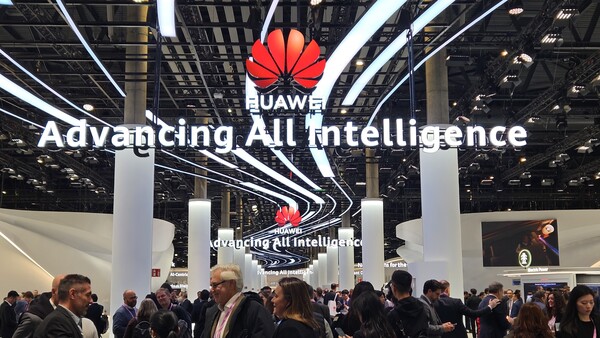
[Barcelona, Spain = DigitalToday reporter Jin-ho Lee] Chinese companies had a prominent presence at MWC26 this year. They showcased large numbers of new artificial intelligence (AI)-based solutions, robots and smart devices, forming a major axis in the global competitive landscape.
At MWC26, which opened on March 2 local time in Barcelona, Spain, a wave of China-led technology continued. Beyond a simple exhibition, companies highlighted both commercialisation and global expansion strategies, drawing the attention of visitors and industry officials.
◆ China’s tech rise on display... Chinese company booths packed with visitors
Huawei pulled in visitors with a 1,200-square-metre large booth that filled most of Hall 1. It unveiled technologies spanning the IT industry, including its latest flagship smart devices, an AI-enabled self-healing network solution, energy optimisation technology and an industrial AI platform.
A space displaying smartphones including the tri-fold Mate XT and the Mate 17 was packed with visitors seeking hands-on experience. Huawei watches also drew strong interest. In the B2B exhibition area, featuring intelligent mobile transmission technology and power solutions for the 5G-Advanced and 6G eras, a steady stream of industry officials came for consultations.
Huawei introduced IT solutions applicable to various industries such as healthcare, finance and manufacturing at this year’s MWC. On site, it was described as an “IT department store”. A Spanish visitor met at the Huawei booth said, “There’s a lot to see in the large booth,” adding, “As a company representing China, it also has a diverse product lineup.”
Xiaomi also drew the attention of visitors and industry experts with its technological capabilities. Xiaomi unveiled its new smartphone Xiaomi 17 at a global launch event held the day before MWC26 opened. The product targets the high-end market while also offering price competitiveness. Xiaomi 17 Ultra in particular drew attention for a high-performance camera developed in collaboration with Leica. Another feature is that it has the thinnest and lightest design in the Ultra series.
It also introduced an AI-driven smart ecosystem. Xiaomi unveiled the Xiaomi Electric Scooter 6 series and a full lineup of Mijia smart home appliances. In mobility, it displayed the Xiaomi SU7 Ultra electric vehicle and the concept model Xiaomi Vision Gran Turismo, presenting its future mobility strategy.
The head of a South Korean telecom carrier also expressed surprise at Xiaomi. Jae-heon Jung (정재헌), CEO of SK Telecom, who visited the Xiaomi booth, said, “Xiaomi was a bit surprising.” He added, “In the AI era, I think devices, networks and AI will all be connected, and Xiaomi seems to have shown it can realise that entire connection.”
Another characteristic of Chinese companies is that they showcase distinctive products. Honor, a smart device brand spun off from Huawei, ran demonstrations of a robot phone and humanoid robots. The robot phone in particular has been highly anticipated since before MWC26 opened. It features a 200-megapixel camera in the form of a robotic arm mounted on the top of the smartphone, minimising shake like a gimbal and tracking subjects.
A visitor met at the Honor booth said, “China always turns imagined technology into reality,” while repeatedly capturing images of the products on a smartphone. Alongside the robot phone, Honor is stepping up its push into global markets by unveiling the premium foldable Magic V3.
◆ Chinese carriers join forces... ‘Mobile AI Innovation Initiative’ launched
A total of 350 Chinese companies participated in MWC this year. That is the third-highest after Spain (750) and the United States (443). It is about twice the number of South Korean participants, with South Korea ranking fourth at 182 companies. Chinese companies’ active participation in MWC is not unrelated to U.S.-China technology tensions. As participation in CES in the United States has weakened, they have mobilised their full capabilities in telecom and AI solutions and products at MWC, a mobile exhibition.
China’s AI and telecom technologies are assessed as already having reached a world-class level. Chinese telecom carriers are countering global telecom giants, including those in the United States, through nationwide coordination. China Mobile, China Telecom and China Unicom, the country’s three major carriers, launched a “Mobile AI Innovation Initiative” with the GSMA, the organiser of MWC.
China currently has more than 10,000,000 5G-A users, indicating a broad base for next-generation technologies. The electric vehicle and smart device sectors are also assessed to have secured strong technological competitiveness, unlike in the past. The industry expects that if the Chinese technologies unveiled at this MWC are commercialised in earnest, they will also affect the market share of South Korean companies.
A telecom industry official said, “Now it should be called not ‘a mistake from the continent’ but ‘the continent’s class’.” The official added, “To respond to a volume offensive backed by capital strength, South Korean companies should also consider more active alliances and cooperation.”
 Jin-ho Lee
jhlee26@d-today.co.kr
Jin-ho Lee
jhlee26@d-today.co.kr