
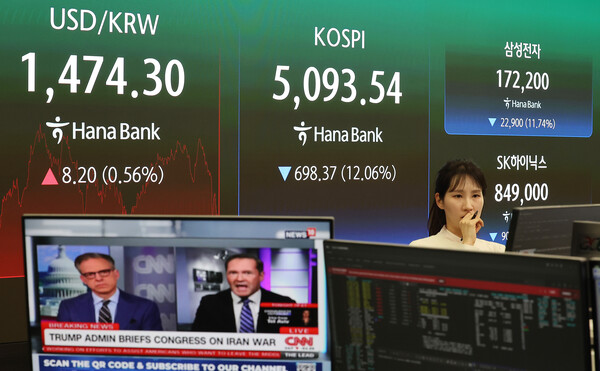
South Korea's stock market plunged more than 12 percent intraday on the fallout from Middle East geopolitical risks, setting a record for the biggest decline and surpassing the drop seen during the Sept. 11 attacks. Major brokerages and experts, however, viewed it as a short-term correction and forecast the medium- to long-term upward trend would remain intact. They said the shock had the hallmarks of a cooling-off process after a recent surge in the index.
On Tuesday, the KOSPI extended Monday's 7.24 percent plunge, posting a second straight day of record losses and stoking extreme fear in the market.
Foreign investors dumped shares from the opening bell, triggering a second straight day of a sell-side sidecar. A circuit breaker was also activated, halting stock trading for 20 minutes after the index stayed down more than 8 percent for at least 1 minute.
As of 12:44 p.m., the KOSPI was down 732.46 points, or 12.65 percent, at an intraday low of 5,059.45. That exceeded the previous record decline of 12.0 percent during the Sept. 11 attacks, setting a new all-time record drop.
At the same time, the KOSDAQ also tumbled more than 14 percent intraday amid indiscriminate selling. The won hit its weakest past 1,500 per dollar for the first time since the 2009 global financial crisis as safe-haven demand peaked.
The direct cause of the unprecedented market plunge was a rapid spread of Middle East geopolitical risks following U.S. and Israeli air strikes on Iran and the death of Iran's supreme leader Ayatollah Ali Khamenei.
With the possibility of a full closure of the Strait of Hormuz raised, fears of a global energy security crisis and a resurgence in inflation swept the market. Major Asian markets, including Japan's Nikkei, also fell sharply in tandem, including in South Korea.
Experts said foreign investors put top priority on converting funds into cash in South Korea, viewed as the most liquid and easily tradeable market globally, as the external environment shifted abruptly.
Han Ji-young (한지영), a researcher at Kiwoom Securities, said market participants were hit by a sharp fall as they assumed the Middle East war would spiral into the worst-case scenario, such as an all-out armed conflict or a ground troop deployment. He said Nasdaq futures were down about 0.6 percent and West Texas Intermediate crude was up about 0.7 percent. That suggests the risk of the worst scenario materialising is not high, he said.
When major geopolitical risks have erupted in the past, such as Middle East wars or North Korean military provocations, global stock markets have generally rebounded quickly after a short-term plunge and recovered prior peaks, suggesting a clear learning effect.
When the Russia-Ukraine war broke out, the KOSPI posted a cumulative 20 percent drop over 6 months. This plunge, however, recorded a drop of about 19 percent in just 2 trading days.
The dominant view is that the stock drop has come at an irrational pace that has reflected almost all the bad news that can be expected at this point in an extremely short period of time.
Kim Seok-hwan (김석환), a researcher at Mirae Asset Securities, also forecast that the most important variable in the pattern of war is time, and that if the situation does not become prolonged, the market will soon regain resilience.
Brokerages said the sharp market fall was triggered by the external shock of the Iran situation, but was essentially a healthy adjustment needed to cool overheating after the KOSPI's surge past the 6,000 level in a short period.
Lee Eun-taek (이은택), a researcher at KB Securities, said it is generally easy to think there will be no big correction in a bull market, but in reality it is the opposite. He said the market is plunging on the Iran situation, but even without such an external factor, the second quarter around March to May was originally a period vulnerable to risk and corrections.
The plunge has instead lifted the valuation appeal of South Korean stocks to the highest level since the financial crisis. The KOSPI's 12-month forward price-to-earnings ratio, calculated at the 5,050 level, fell to the low 8.0 times range.
That is the second-lowest level after the 2008 global financial crisis, when it was 6.3 times, and corresponds to a historical average bottom level.
The market's most core fundamental is explosive earnings momentum in semiconductors led by Samsung Electronics and SK Hynix, and firm trust in a global artificial intelligence super-cycle.
South Korea's leading semiconductor firms play an irreplaceable core role in the value chain for building global AI infrastructure, and the combined operating profit forecasts for major semiconductor companies expected this year have continued to be revised higher without wavering.
In addition, ample idle liquidity that steadily accumulated during the phase above the KOSPI 6,000 level, along with the government's strong stock market revitalisation policy, is serving as a final safety valve that firmly supports the market's downside even during a crash.
According to the Korea Financial Investment Association, investor deposits, which are in the nature of direct waiting funds for stock investment, recently exceeded 111 trillion won, setting a new record high.
At the same time, standby funds in the form of short-term financial products such as cash management accounts and repurchase agreements have also piled up to near 100 trillion won, the largest amount ever.
In addition, capital market advancement policies that the government and financial authorities have been pushing consistently are also making a decisive contribution to resolving the chronic valuation discount in South Korean stocks.
A proposed revision to the Commercial Act to expand directors' duty of loyalty from the company to all shareholders, and discussions of policy support to raise shareholder return rates, are building long-term trust in the market and preventing a structural outflow of foreign funds.
Han said for the KOSPI to structurally fall below the 4,000 level, the earnings improvement outlook itself that powers the KOSPI rally would have to be completely damaged, but there are no signs of that at all. He advised that the market is now passing through a peak of fear, so it is necessary to avoid hasty decisions to sell, such as joining panic selling.
 Oh Sang-yup
yub@d-today.co.kr
Oh Sang-yup
yub@d-today.co.kr