
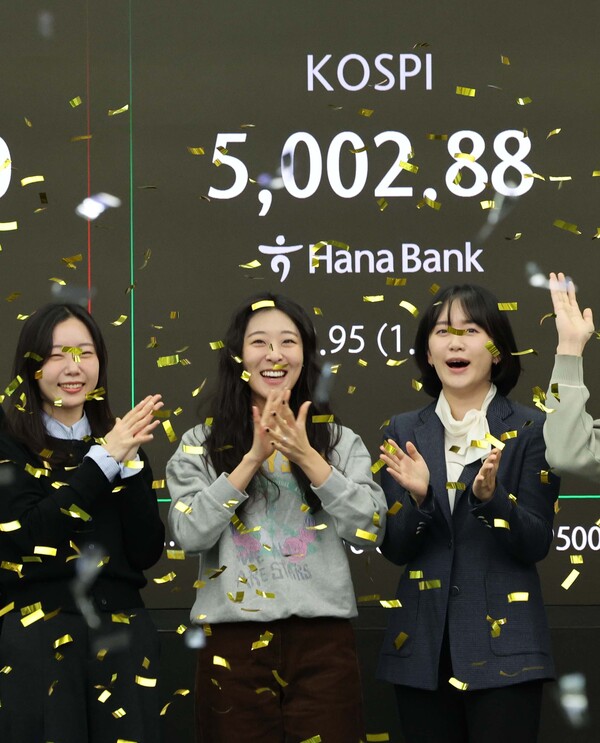
[Digital Today reporter Sang-yeop Oh (오상엽)] South Korea's KOSPI index broke above the 5,000 mark for the first time, setting a new milestone for the country's stock market. It comes 46 years after the Korea Composite Stock Price Index, or KOSPI, began at 100 on Jan. 4, 1980.
The KOSPI was up 92.21 points, or 1.88 percent, at 5,002.14 as of 9:01 a.m. on Wednesday, the Korea Exchange said, ushering in what it called the 5,000 era.
After breaking above 4,000 for the first time last year, the KOSPI has extended its climb at a steeper pace this year.
The index has set fresh record highs for 12 straight sessions, lifting investor expectations. An improving semiconductor cycle, the government's policies to revitalise capital markets and abundant liquidity have combined to make the 5,000 era a reality rather than a dream.
The move above 5,000 is a major milestone that will be remembered in South Korea's stock market history. The KOSPI has continued a stepwise rise while overcoming repeated crises.
The KOSPI first entered four-digit territory in 1989. It closed at 1,003.31 on March 31, 1989, opening the 1,000 era for the first time, nine years after the index was first calculated in 1980.
It then took 18 years to reach 2,000. After falling into the 200s during the 1997 International Monetary Fund foreign exchange crisis, it opened the 2,000 era only on July 25, 2007, when it hit 2,004.22.
The 3,000 era arrived 13 years later, in 2021. After plunging to the 1,400 level during the 2020 COVID-19 pandemic, the KOSPI closed at 3,031.68 on Jan. 7, 2021, breaking above 3,000 for the first time on a buying surge by retail investors dubbed the Donghak Ant movement.
The move above 4,000 came faster. Backed by a recovery in the semiconductor cycle and government measures to boost the stock market, it rose above 4,000 on Oct. 27 last year. It then reached 5,000 in just three months, accelerating its rise.
With the KOSPI opening the 5,000 era, attention is also focused on whether retail investors known as "Seohak ants" who moved into overseas stock markets will return. The government has put forward an aggressive package of tax incentives to encourage their return to the domestic market.
The Ministry of Finance and Economy plans to create a Returning to the Domestic Market Account, or RIA, for investors who sell overseas stocks and move funds into the domestic market. It plans to discuss amendments to the Special Tax Treatment Control Act at an extraordinary session of parliament in February.
Under the government plan, investors who dispose of overseas stocks within the first quarter and reinvest in domestic shares can receive a full 100 percent reduction in capital gains tax on overseas stocks. Those who return in the second quarter would receive an 80 percent reduction, and those returning in the second half would receive a 50 percent reduction. The per-person cap is 50 million won, based on the sale amount.
This is seen as a strong incentive to bring overseas outflows back into the domestic market, in line with the KOSPI's recent record rally.
The securities industry sees whether the KOSPI can hold at 5,000 as a key variable for Seohak ants returning. It says U.S. stocks have moved sideways since the second half of last year due to the impact of high interest rates and concerns about slowing growth at big tech companies, while the domestic market has surged on improved results at semiconductor and secondary battery companies, providing sufficient rationale for fund flows.
Caution is also widespread. Some point out that tax benefits alone will be insufficient to fully bring back investors who have become accustomed to the U.S. market, where expected returns are high.
A securities industry official said, "The biggest reason Seohak ants crossed borders was not taxes but returns." The official added, "A full-scale money move will happen only if it proves that the KOSPI 5,000 era is not a temporary bubble but a 'level-up' backed by stronger shareholder return policies and earnings growth at companies."
 Sang-yeop Oh
yub@d-today.co.kr
Sang-yeop Oh
yub@d-today.co.kr