
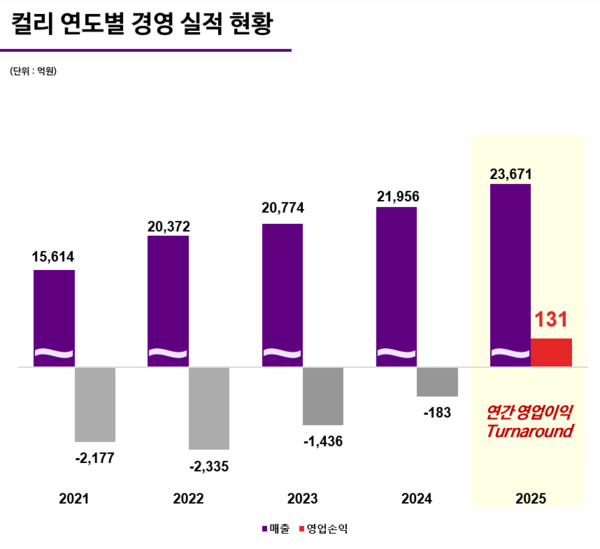
Retail tech firm Kurly posted its first-ever operating profit last year. Revenue and gross merchandise value also hit record highs.
Kurly said on Tuesday, in its 2025 earnings call, that it posted a consolidated operating profit of 13.1 billion won last year, its first full-year operating profit. It marked a fourth consecutive quarter of operating profit. Revenue rose 7.8 percent from a year earlier to 2.37 trillion won.
Total gross merchandise value (GMV) rose 13.5 percent to 3.53 trillion won. Kurly posted GMV growth of more than 10 percent for four straight quarters last year. In the fourth quarter, GMV grew 16.2 percent, the highest level in the past three years. The company explained that Kurly's GMV growth last year was more than double South Korea's online shopping growth rate by transaction value, as reported by Statistics Korea.
The company cited steady growth in its core businesses such as fresh food as a key reason it achieved its first full-year operating profit. It also said portfolio diversification, including new businesses, had an impact. The company said a fundamental improvement in its profit structure helped it expand its business and improve quality growth.
Kurly maintained solid growth momentum in its core businesses last year. According to the company, Market Kurly grew 11 percent from a year earlier based on GMV, while Beauty Kurly also maintained growth. It said stronger fresh food categories, a push to bolster indie beauty, and expansion in fashion and living led to improved results.
In diversification, results from its fulfillment service (FBK) and seller-shipped products (3P) were effective. GMV from 3P, including FBK, grew 54.9 percent over the year. Product competitiveness in areas such as fashion, kitchenware and interior items, along with the competitiveness of the FBK service, drove growth. Kurly N Mart, launched with Naver, saw average monthly GMV rise by more than 50 percent each month since its launch in September last year.
The company also said it succeeded in improving its fundamentals by upgrading operations at its Gimpo, Pyeongtaek and Changwon logistics centers and improving order processing efficiency. The cost of sales ratio fell 1.5 percentage points from a year earlier, while the selling, general and administrative expense ratio rose by about 0.2 percentage points, maximizing profit.
Kurly also saw growth in loyal customers. According to Kurly, its monthly active users (MAU) at the end of last year rose more than 30 percent from a year earlier. The number of active Kurly Members subscribers increased each month to about 1.4 million. In the fourth quarter last year, it rose by more than 200,000.
Jong-hoon Kim (김종훈), Kurly's chief financial officer, said: "The first annual profit is meaningful in that, through structural innovation, we established a business model in which sales growth directly translates into profit expansion." He said, "With sustainable growth drivers secured on the back of a proven profit model, we will speed up efforts to ensure new businesses gain a stable foothold in the market and to enhance future value."
 Shin-hye Ahn
doubletap@d-today.co.kr
Shin-hye Ahn
doubletap@d-today.co.kr