
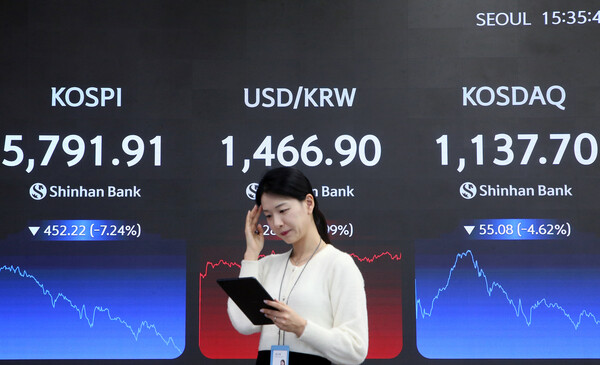
Geopolitical risks in the Middle East have risen sharply after U.S. and Israeli air strikes on Iran, prompting South Korea's financial sector to activate emergency response systems. With U.S. President Donald Trump suggesting the situation could be prolonged, concerns are growing about heightened volatility in key indicators such as international oil prices, the exchange rate and interest rates.
According to the financial sector on March 4, the five major financial holding groups — KB Financial Group, Shinhan Financial Group, Hana Financial Group, Woori Financial Group and NH NongHyup Financial Group — have fully activated group-level crisis response systems and begun market monitoring and corporate support.
KB Financial is operating an emergency response system led by Chairman Jong-hee Yang (양종희), with chief executives of major affiliates and key executives participating, and is checking key indicators such as the exchange rate, interest rates and oil prices in real time.
Its affiliate KB Kookmin Bank has been running the "KB Disaster Recovery Financial Support Programme" since March 1. It plans to provide up to 500 million won in working capital and facility recovery funds to companies operating in conflict areas and to export-import firms, and apply special preferential interest rates of up to 1.0 percentage point. It will also support extensions for loans reaching maturity without requiring borrowers to repay principal.
Shinhan Financial held a group crisis management council meeting and activated a weekly inspection system while keeping the crisis management level at "caution". Shinhan Bank will provide up to 1 billion won in working capital and facility recovery funds through the "Shinhan Disaster Recovery Financial Support Programme". It will offer extensions for loans maturing within 3 months and special preferential interest rates of up to 1.0 percentage point. It is also conducting checks of its IT and information security systems in parallel to prepare for possible cyber attacks.
Hana Financial is consulting with relevant government agencies on humanitarian support measures for South Korean residents in the region. Hana Bank has also prepared an emergency liquidity supply plan totalling 12 trillion won and will provide up to 500 million won in emergency business stabilisation funds for affected companies. It will also offer measures including maturity extensions for credit facilities of up to 1 year, deferrals of instalment repayments for up to 6 months, and loan rate reductions of up to 1.0 percentage point.
Woori Financial has also activated emergency response systems across all affiliates. Woori Bank will provide up to 500 million won in working capital through its "Emergency Business Stabilisation Funds for SMEs Affected in the Middle East" and apply preferential rates and fees, along with "fast-track" screening. It plans to contribute 42 billion won to the Korea Trade Insurance Corp to support guarantee-backed loans totalling 800 billion won, up to 10 billion won per company.
NH NongHyup Financial immediately activated its "Emergency Monitoring and Response System for Financial Markets". NH NongHyup Bank will provide up to 500 million won in new funds and special preferential interest rates of up to 2.0 percentage points for companies expected to suffer direct or indirect damage, and defer principal and interest repayments for up to 12 months.
iM Financial Group has also built an emergency response system and proactively checked affiliate risk ratios and foreign currency liquidity conditions. It also plans to implement measures including preparing private-sector responses to protect customers by affiliate, managing industries sensitive to oil prices and exchange rates, and managing FX positions for companies related to the Middle East.
FINANCIAL AUTHORITIES ALSO MOVE TO 24-HOUR MONITORING
The won-dollar exchange rate also surged on the day due to the impact of the Middle East situation. In the Seoul foreign exchange market on March 3, the won-dollar rate opened at 1,462.3 won, up 22.6 won from the previous session. Analysis suggests that as international oil prices rise due to the incident, the won-dollar rate is more likely to remain at elevated levels.
Financial authorities have also moved to respond. Vice Chairman Lee Eok-won (이억원) of the Financial Services Commission convened a joint meeting of related agencies on March 3 to review the possibility of increased volatility in share prices and the exchange rate depending on developments in the Middle East situation.
The authorities said they would actively use a "100 trillion won plus alpha" market stabilisation programme if needed to support the corporate bond and commercial paper markets and to ensure a soft landing for real estate project financing. They also said they would swiftly execute existing financial support programmes totalling 13.3 trillion won for small and medium-sized enterprises with a high share of exports to the Middle East, including 8 trillion won from Korea Development Bank, 2.3 trillion won from Industrial Bank of Korea and 3 trillion won from the Korea Credit Guarantee Fund.
The Bank of Korea also held a "Middle East situation review task force" meeting chaired by Governor Chang-yong Rhee (이창용) to discuss the impact on the domestic financial sector and the economy. It plans to closely examine the reaction of domestic financial and foreign exchange markets, which opened after the Middle East situation, and how related risks unfold.
The central bank said it plans to operate the Middle East situation task force for the time being to discuss the possibility that the situation could continue for a considerable period, its financial and economic impact, and response measures by scenario. It added it would more closely check changes in domestic and overseas financial and foreign exchange markets through a 24-hour monitoring system linked with overseas offices and respond in a timely manner if needed.
A financial sector official said, "We plan to provide liquidity while managing risks so that market volatility does not spread into a contraction in the real economy."
 Ji-young Lee
ljy@d-today.co.kr
Ji-young Lee
ljy@d-today.co.kr