
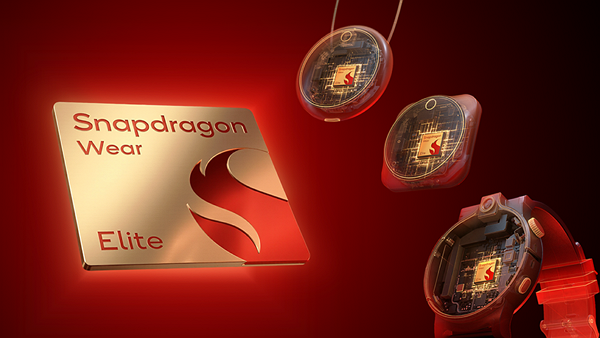
Qualcomm unveiled Snapdragon Wear Elite, a next-generation wearable processor that it said sharply improves on-device AI performance and power efficiency, opening development possibilities not only for smartwatches but also for next-generation wearables such as AI pins and pendants.
On March 2 local time, IT outlet The Verge and others reported that Qualcomm announced Snapdragon Wear Elite, its top-tier chipset for wearable devices, at MWC 2026 in Barcelona, Spain.
The new product applies the premium "Elite" brand, previously used only for smartphones or laptops, to wearables for the first time, and is built on a 3-nanometre process. Qualcomm said the chipset can improve CPU performance by up to 5 times and GPU performance by up to 7 times versus the previous model. It also supports Android, Wear OS and Linux, which it said can be used for startups to develop their own software.
The core of Snapdragon Wear Elite is its on-device AI capability, which runs artificial intelligence on the device without a cloud connection. The chipset includes both an eNPU that handles low-power AI functions such as keyword recognition and activity detection, and a Hexagon NPU that processes complex computations. The Hexagon NPU supports large language models with up to 2 billion parameters and can process 10 tokens per second. This enables personalized AI functions based on user voice, location, movement and camera data, and features such as automatically recording meeting content or providing tailored recommendations could be developed in the future.
There is also potential improvement in battery efficiency and connectivity. Qualcomm said a redesigned architecture can extend overall battery life by about 30 percent versus the previous model and cut power consumption by 40 percent during GPS tracking. It also supports 9V fast charging, enabling 50 percent charge in about 10 minutes, and offers connectivity options including satellite communications (NB-NTN), 5G, Bluetooth 6.0 and ultra-wideband (UWB), which can be used to improve data synchronisation between devices and communications performance.
Global manufacturers including Google, Samsung Electronics and Motorola may adopt the platform, and Samsung Electronics is expected to use it in the Galaxy Watch9 that is scheduled to be released this summer. Motorola could use it to develop new form factors such as Maxwell, an AI pendant concept, while Google is also assessing the possibility of delivering a smarter user experience in future Wear OS devices.
With Qualcomm, a key component maker, supplying a chipset dedicated to AI wearables, various forms of personal AI devices, including collaboration devices by Jony Ive and Sam Altman, could also emerge within months.
 Hong Kyung-min
hongm@d-today.co.kr
Hong Kyung-min
hongm@d-today.co.kr