
Dnotitia is making a full-scale entry into the enterprise AI Storage architecture business. It aims to target the global AI infrastructure market with a vertically integrated solution combining KV cache reuse technology, which it says can overcome capacity limits of high-bandwidth memory (HBM), with dedicated accelerator semiconductors.
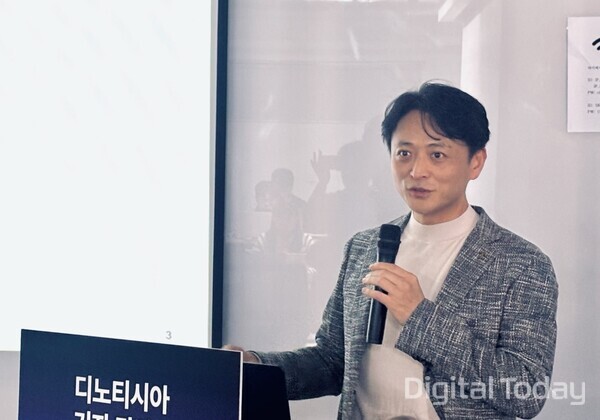
Dnotitia CEO Moo-kyoung Chung(정무경) outlined an inference-focused infrastructure strategy at a briefing on Tuesday, saying the era has arrived in which AI directly consumes source data from large-scale storage. In the past, people manually searched structured data, but AI now explores vast unstructured data such as documents and videos based on semantic similarity and uses it directly for inference, he said. He also said the boundary between databases and storage is breaking down, and storage is being elevated from simple retention to an execution layer that completes AI intelligence.
Against that backdrop, the company put forward a strategy to integrate the multi-layered memory system required by AI agents into a single data stack at the storage level. Dnotitia said one of the main reasons many companies are struggling to adopt AI is that AI models themselves have no memory, forcing users to give the same instructions from scratch each time.
To address that, the company proactively presented an External Knowledge memory that converts unstructured data into high-dimensional vectors to calculate similarity, and a Long-term Memory storage that accumulates user interaction history on a time-series and semantic basis.
The area where demand is most concentrated is the KV Cache layer, which corresponds to short-term working memory. As AI service sessions and context lengths grow longer, the size of KV cache that temporarily stores previous token information is surging, worsening shortages in GPU HBM capacity, the company said.
In cloud environments where many users share GPUs, the bottleneck is becoming more pronounced. To resolve it, the company presented KV cache reuse technology that stores KV cache in storage when there are no requests and reloads it when needed. It said this can reduce the cost of repeated computation and minimise prefill latency.
To support this, Dnotitia has built a vertically integrated architecture spanning software and hardware. Based on its vector database, Seahorse, which is dedicated to semantic search, it designed its own dedicated semiconductor, VDPU (Vector Data Processing Unit), to accelerate data computation at the hardware level.
The VDPU chip, which is separated from general-purpose processors to maximise power efficiency and search stability, completed tape-out in December last year and will enter mass production next year. The company also plans to develop high-performance NVMe storage compatible with the interconnect and memory subsystem (ICMS) structure of NVIDIA's Rubin platform to raise inference efficiency between prefill nodes and decoding nodes.
◆Secures at least 100 billion won in investment, first AI storage release in second half
Fundraising for business expansion is also in its final stages. Jung said the company has secured investment of about 100 billion won so far and expects to secure more as it nears completion in March. Major investors are venture capital firms. Even though its dedicated chip has not entered full-scale mass production, Dnotitia recorded 3.15 billion won in revenue last year from software alone, including its cloud and API services. It targets more than a threefold increase in revenue this year from a year earlier.
Dnotitia's first target segment is companies seeking to build specialised AI solutions using internal raw data. It aims to help companies turn data into an asset and use it proactively in the AI era by providing an integrated solution for data access.
Jung said South Korean companies make some of the world's best NAND flash-based SSD hardware, but few create and sell added value through storage systems themselves for data centres. He said the company will lead a shift in the technology paradigm, starting with the release of its first AI storage product in the second half.
 Daegeon Seok
d2dg@d-today.co.kr
Daegeon Seok
d2dg@d-today.co.kr