
Geopolitical risks in the Middle East are rising after a U.S. attack on Iran, fueling concern that South Korea's industry could fall within its impact zone.
As Europe faced a major crisis due to energy shortages after the outbreak of the Russia-Ukraine war in 2022, observers say the longer the situation lasts, the bigger the blow could be to regions like South Korea that are heavily dependent on Middle Eastern energy.
In that case, expectations are rising that wide-ranging negative effects could spread across the economy, from the semiconductor industry, which has been driving South Korea's recent recovery, to the petrochemical sector undergoing painful restructuring.
According to the industry on March 3, the Hormuz Strait, which Iran has moved to block, is a key energy shipping route through which about 20 to 30 percent of global oil cargo passes. It also serves as an "aorta" for South Korea's energy transport.
South Korea's imports of Middle Eastern crude accounted for 70 percent of the total last year, and more than 95 percent of that passed through the Hormuz Strait.
Japan's reliance on Middle Eastern crude is around 90 percent, and Taiwan's is about 70 to 80 percent, making it no exaggeration to say Asia as a whole depends on the Middle East for energy.
As a result, analysis suggests that if the Hormuz Strait is actually blocked, the impact on South Korea and other Asian countries would be enormous.
Just as Europe suffered a crisis after the outbreak of the Russia-Ukraine war due to dependence on Russian gas, Asia could face difficulties because of its dependence on Middle Eastern crude.
The problem could grow because Asian countries are not well positioned geographically to secure alternative routes, and the high share of long-term crude contracts could mean switching supply sources would take considerable time.
South Korea is pursuing diversification of crude import sources as a medium- to long-term policy. But Korea National Oil Corp data showed that as of January this year, 71 percent of the country's crude imports were from the Middle East, with 23 percent from the Americas, 4 percent from Asia and 2 percent from Africa.
Meanwhile, a sense of crisis is also growing as international oil prices have already begun to surge.
On the ICE Futures Exchange the previous day, Brent crude futures for May delivery settled at $77.74 a barrel, up 6.7 percent from the previous session.
On the New York Mercantile Exchange, West Texas Intermediate crude futures for April delivery also rose 6.3 percent from the previous session to $71.23 a barrel.
Forecasts are mounting that oil prices will top $100 a barrel if the situation does not end early.
Rising oil prices could lead to higher energy costs, increasing pressure again to raise electricity rates.
Industrial electricity rates rose about 70 percent over 7 increases after global fuel costs surged following the outbreak of the Russia-Ukraine war in 2022.
With international oil prices recently stabilising in the low $60 range, calls for electricity rate cuts have grown. But there is also speculation that the latest situation could mean preparing for another rise.
That could weigh on industry overall, while power-intensive sectors such as semiconductors, steel, petrochemicals and displays could take a direct hit to profitability.
Semiconductor companies such as Samsung Electronics and SK Hynix are accelerating output increases amid rapid growth in the artificial intelligence industry. As their power use rises, their cost burden is expected to grow.
For the petrochemical sector, which has entered restructuring due to oversupply from China and weak global demand, an additional electricity burden is expected to make a recovery even more difficult. Limits also remain because weakened demand makes it hard to reflect higher oil prices in product prices.
The refining industry is seen as potentially improving profitability in the short term due to better refining margins, but if the rise in oil prices is prolonged it cannot escape the impact zone of weak domestic demand and slowing demand.
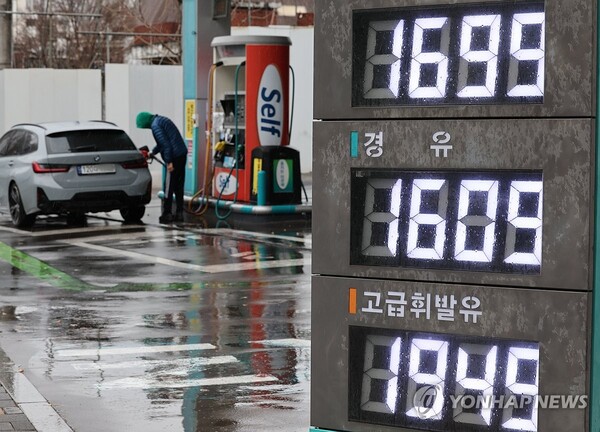
That view is gaining traction as the likelihood grows that domestic pump prices, already on an upward track, could rise further.
Gas station fuel prices, which had fallen for 10 consecutive weeks, rose for 2 straight weeks through last week ahead of the latest situation.
A Korea Petroleum Association official said domestic gas station prices are typically reflected with a lag of 2 to 3 weeks and forecast that the upward trend could become steeper.
The association also said that if the sharp rise in oil prices persists, it could lead to reduced driving and weaker travel demand.
In the wake of the latest situation, countries around the world may pursue policies to strengthen energy security, expanding petroleum product stockpiles and tightening export controls. That could make energy supply and demand even more difficult in the long term.
Lee Chung-jae (이충재), an analyst at Korea Investment & Securities, said energy is the foundation that supports a country's economy and society, and rising energy prices inevitably lead to weaker consumption and investment. He said that if the situation is prolonged, both Asian and European countries risk facing energy shortages like those Europe experienced during the Russia-Ukraine war.
[Yonhap News Agency]
 Online Team
d-today@d-today.co.kr
Online Team
d-today@d-today.co.kr