
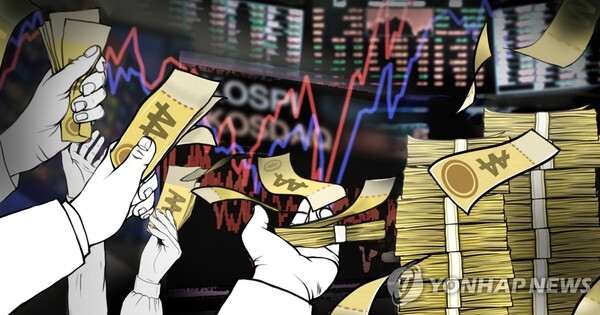
The KOSPI extended a sharp rise last month, including crossing the 6,000 mark for the first time, pushing average daily trading value above 30 trillion won for the first time on record.
The Korea Exchange said on Monday the KOSPI’s average daily trading value last month was 32.234 trillion won, the highest ever.
That was up 19 percent, or 5.178 trillion won, from January’s 27.056 trillion won.
It is seen as the result of the KOSPI repeatedly rallying to record highs on a U.S.-led boost for tech stocks and expectations that the government’s third revision to the Commercial Act will pass.
The KOSPI rose 20 percent last month. On Feb. 25, it crossed 6,000 for the first time and on Feb. 26 it also reached the 6,300 level.
Last month’s KOSPI trading value appeared to concentrate mainly in large semiconductor stocks such as Samsung Electronics and SK Hynix.
Average daily trading value last month for Samsung Electronics, SK Hynix and Samsung Electronics preferred shares was 10.502 trillion won, accounting for 33 percent of total KOSPI trading value over the same period.
Stock turnover was also brisk.
The KOSPI market’s listed share turnover ratio last month was 28.0 percent, the highest in 3 years and 10 months since April 2022’s 35.02 percent.
That was a 55 percent surge from the previous month’s 18.13 percent.
The listed share turnover ratio is trading volume over a given period divided by the number of listed shares. A higher ratio means more active turnover.
Brokerages expect the KOSPI to rise in the longer term, but say it could go through a short-term pause.
They say there is a burden from a potentially short-term peak after the recent sharp rise.
Myung-gan Yoo (유명간), an analyst at Mirae Asset Securities, pointed out that the KOSPI’s 12-month forward price-to-earnings ratio is 10.4, in line with the historical average, but excluding Samsung Electronics and SK Hynix the PER is 13.2 and the price-to-book ratio is 1.27, raising valuation burdens.
Short-term volatility could also increase as Middle East geopolitical tensions rise after Iran’s Supreme Leader Ayatollah Seyyed Ali Khamenei died in U.S. and Israeli attacks, while uncertainty persists over the Trump administration’s tariff policies.
Kyeong-min Lee (이경민), an analyst at Daishin Securities, expected that the trend of record highs would not reverse, saying the KOSPI is currently rising mainly on upward revisions to earnings forecasts for the semiconductor sector, differentiating it from past phases driven by liquidity.
He added that earnings forecast momentum could slow until the end of March shareholder meetings and ahead of the first-quarter pre-earnings season, and that uncertainties such as whether a hearing schedule will be confirmed for Kevin Warsh as the next chair of the U.S. Federal Reserve could also add to volatility.
[Yonhap News Agency]
 Online Team
d-today@d-today.co.kr
Online Team
d-today@d-today.co.kr