
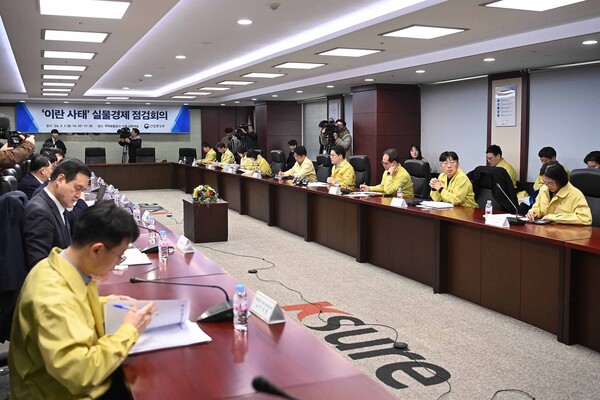
The government has launched an emergency check on the real economy in response to Middle East instability triggered by U.S. and Israeli air strikes on Iran. The Ministry of Trade, Industry and Energy said on Saturday it held a "second meeting to review the real economy" at the Korea Trade Insurance Corp in Jongno district, Seoul, chaired by Vice Minister Moon Shin-hak (문신학).
Officials from the foreign ministry, the climate energy and environment ministry, the oceans ministry and the Financial Services Commission attended, along with Korea National Oil Corp, Korea Gas Corp, the Korea Trade-Investment Promotion Agency (KOTRA), the Korea Energy Economics Institute and major economic groups. The meeting followed an emergency review led the previous evening by Industry Minister Kim Jeong-gwan (김정관). Trade officials from the United States, China, Japan and the European Union also joined by video link to share local developments and potential risks.
Geopolitical tensions in the Middle East have risen after Iran's supreme leader Ayatollah Seyed Ali Khamenei died in the air strikes by the United States and Israel. The government said it is checking its emergency response system while also considering the possibility of a closure of the Strait of Hormuz, which accounts for 20 percent of global seaborne crude oil shipments. It said South Korea has secured several months' worth of strategic oil reserves and gas inventories above mandatory levels, leaving it with sufficient capacity to respond to supply and demand conditions for now.
If the situation drags on and private-sector crude inventories fall below a certain level, the industry ministry plans to supply strategic reserves to the domestic market after holding its own assessment meeting. It said Korea National Oil Corp has also started an emergency review under its manual, including steps such as bringing in overseas production volumes, exercising priority purchase rights for joint stockpiles and checking readiness to release strategic reserves.
In trade, the Middle East accounted for 3 percent of South Korea's exports as of last year, not a large share. Since the Red Sea crisis in 2023, major container shipping companies have already shifted to routes that detour around the Cape of Good Hope, limiting the impact on maritime logistics so far.
Still, the government decided to push liquidity support for exporters and provide logistics cost support through export vouchers, considering the ripple effects on exports if higher oil prices and logistics costs persist. It also plans to consider additional measures, such as deploying temporary vessels, if logistics disruptions intensify.
On supply chains, the government will seek to expand domestic output and secure alternative sources for some chemical products with high dependence on the Middle East, including bromine and ethylene glycol for synthetic fibers. It said there has been no direct impact on the power supply so far, but Korea Electric Power Corp and state-run power generation firms decided to strengthen monitoring against the risk of a sharp rise in oil prices and possible disruptions in LNG imports.
The industry ministry said it activated an "emergency task force" on the day the situation occurred, led by Yang Gi-uk (양기욱), head of the Office of Industrial Resource Security. It plans to continue real-time monitoring to prevent oil price swings from being excessively passed through to consumer inflation, including gasoline and gas bills.
 Suk Dae-geon
d2dg@d-today.co.kr
Suk Dae-geon
d2dg@d-today.co.kr