
In the mobile market, "self-supplied" service has long remained a grey area. Users buy a handset directly and sign up separately for telecom service. The lack of a contract is an advantage, but benefits are limited and users often have to handle sign-up procedures on their own, creating a bias that it is a cheap but somehow inconvenient service.
SK Telecom took note of this. Launched in October last year, "air" is an app service that lets users handle everything in one place, from self-supplied activation to point benefits and customer service. The brand name reflects the idea of helping customers with a lighter telecom life, like air, by offering only the core services and benefits they need.
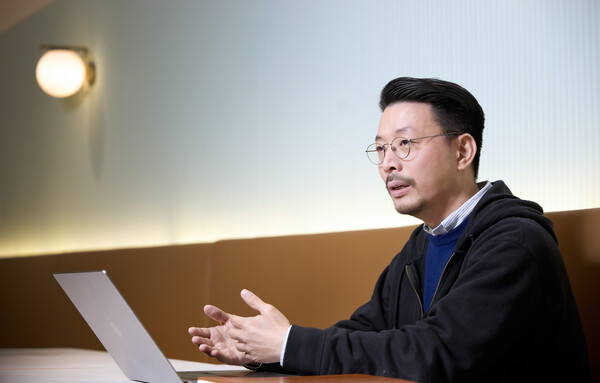
Joon-young Jung, head of SKT's air business team, recently met DigitalToday and said, "There are clearly customers who are used to choosing by separating the handset and telecom service." He added, "Air will establish itself as one option."
Air aims for "telecom minimalism" with essential core functions and a simple plan lineup. Its features can be summed up as data-focused simple plans, a highly usable point system, self-activation, a 365-day customer centre and add-on services limited to the essentials. It targets the market by highlighting a "complete experience" that lets users handle sign-up, activation, cancellation, inquiries and use of benefits in a single app.
Air plans are kept simple with six 5G plans priced from 29,000 won for 7 GB to 58,000 won for unlimited data. They provide essential data, voice calls and text messages while removing unnecessary add-on benefits to lower monthly fees. All plans offer a quality-of-service (QoS) option. Users can keep using data at a set speed without extra charges after using up the included data.
Point rewards are a key advantage unique to air. Carrier membership benefits do not apply, but users can earn points by completing in-app missions such as a pedometer and "Today's Pick." Points can be used for monthly bill discounts or exchanged for gift certificates in the points shop. It is a benefit that has been hard to find in existing self-supplied service. Bonus points are also granted on new sign-ups, meaning even the 58,000-won plan can have the effect of being used in the mid-20,000-won range for 1 year.
Jung said, "We judged that benefits customers can feel in everyday life are necessary." He added, "We are reviewing a structure that would allow points to be earned through in-app product purchases, content and advertising use as well."
He added, "Ultimately, I think the process of using a telecom app itself leading to bill discounts is the most intuitive and biggest benefit." He said, "We plan to design and expand the point structure around this direction."
Activation is also simple. The entire activation process can be completed in about 90 seconds through the app. The service supports eSIM for fast activation, same-day delivery of SIM cards and automatic SIM activation without a confirmation call. When immediate activation is not possible, such as on weekends or at night, reservation sign-up enables automatic activation at 9 a.m. on the next available activation day.
Given the online nature, would service inquiries or consultations be inconvenient. Air operates an in-app customer centre 24 hours a day, 365 days a year. Professional advisers provide real-time one-on-one chat consultations. SKT plans to introduce AI-based chatbot consultations in the future.
Separately from air's advantages, some voices worry about market encroachment. In particular, the budget carrier industry, which has relatively limited funding, argues that SKT is killing the budget carrier market with its self-supplied service. They say it is hard to compete with SKT, which is offering large-scale benefits in a situation where the markets overlap through contract-free and online-based sign-ups.
Jung drew a line on such views. He said, "We have no intention at all to compete with or encroach on the budget carrier market." He added, "I think it is a process in which each operator proposes customer value in different ways." His explanation is that contract-free service is not exclusive to any one operator, and that it is about expanding consumer choice.
For middle-aged and older users, signing up through an app could be a barrier to entry. Jung said, "We are aware there is a hurdle for middle-aged and older customers." He added, "We will review improvements to make the sign-up process more convenient, but we will maintain a structure premised on security and trust to prevent illegal activations." SKT is reviewing ways to further strengthen consultation channels, while also considering building an additional website.
It has also put solid security measures in place. Before launch, air worked with white-hat hackers to complete checks and improvements for source-code vulnerabilities. SKT plans to respond to fraudulent activation cases and strengthen security through continued air service updates.
Jung said, "We aim to keep the basics simple while responding quickly to customers' actual needs." He stressed, "The goal is to quickly reflect customer voices and give the experience of 'the service is developing.'"
 Jin-ho Lee
jhlee26@d-today.co.kr
Jin-ho Lee
jhlee26@d-today.co.kr