
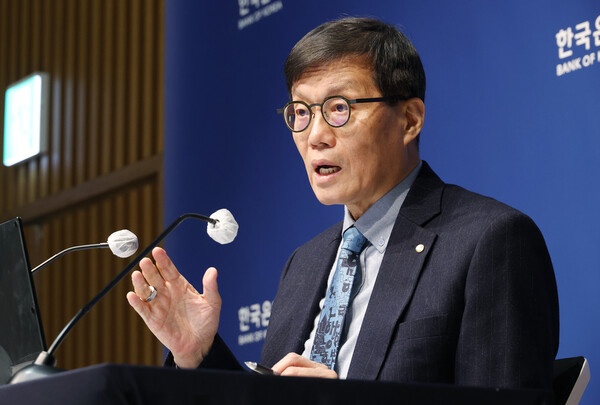
Bank of Korea Governor Rhee Chang-yong cited the exchange rate as the reason for holding the policy rate.
Rhee said at a press briefing on the monetary policy decision on Thursday morning that "it is an undeniable fact that the exchange rate was an important reason for the decision." He said the exchange rate fell by more than 40 won at the end of last year but has risen again to the mid-to-high 1,400s this year, requiring continued vigilance.
He analysed the early-year rise in the exchange rate, saying about three-quarters reflected dollar strength, yen weakness and geopolitical risks. He said the remaining quarter was due to factors unique to South Korea.
Rhee said individual investors repeatedly bought large amounts of dollars when the exchange rate fell to a certain level. He said individual investors' funds for overseas stock investment in January were leaving at a pace similar to or much larger than in October to November last year. He added he would not conclude that stabilisation policies for supply and demand at the end of last year had no effect at all, and said he believed the episode confirmed the country's weaknesses.
He dismissed calls from some quarters to raise the policy rate to lower the exchange rate. He said, "Just six months ago they said we missed the timing by not cutting rates, and now they suddenly say this happened because we did not raise rates as the exchange rate rose."
He said the Bank of Korea does not set interest rate policy by looking at the exchange rate, but by looking at the effect of the exchange rate on inflation. He said trying to control the exchange rate with interest rates would require raising rates by about 2 to 3 percentage points and could cause many people to suffer.
He again drew a line against concerns about a financial crisis stemming from the high exchange rate. Rhee said South Korea is a net external creditor nation, so even if the exchange rate rises it is not a financial crisis like in the past. He said it differs from past situations when companies collapsed and defaulted because they could not repay foreign currency debts. He said it was excessive to say the South Korean economy is collapsing and the exchange rate will keep rising.
He said that regardless of who becomes the winner in the artificial intelligence (AI) industry, he believes the outlook for South Korea's semiconductor industry is good over at least the next year.
The rate hold on Thursday was decided unanimously by the Monetary Policy Board. Among the board members, Shin Sung-hwan had been the only one to maintain a minority view that rates should be cut, but changed his position this time.
In the board members' three-month forward guidance, 5 of 6 said it was likely the policy rate would be kept at 2.50 percent even in three months. The 5 also said they expected the current economic situation to be likely to persist over the next three months.
The remaining member said the possibility of a cut to a lower level than at present should also be left open, and cited weak momentum in the domestic demand recovery as the basis, Rhee said.
Rhee said he does not think a policy rate hold will fully bring the real estate market under control, and that the government needs comprehensive policies. He said the capital area housing market is at a high level, with Seoul's price increase rate reaching an annualised 10 percent. He said it is a situation that requires attention to the impact of the capital area housing market on household debt.
 Ji-young Lee
ljy@d-today.co.kr
Ji-young Lee
ljy@d-today.co.kr