
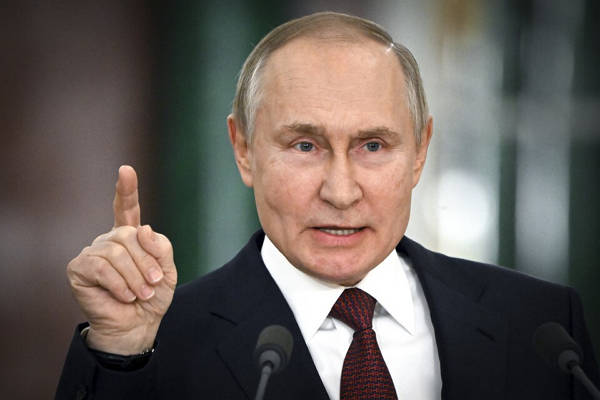
[DigitalToday intern reporter Seung-a Yoo] Russian President Vladimir Putin (블라디미르 푸틴) proposed that African countries join a cross-border payment system based on digital currencies, including cryptocurrencies. He argued it could reduce reliance on Western financial networks and strengthen financial sovereignty.
On Oct. 29 (local time), blockchain outlet Cryptopolitan reported that Putin urged African leaders to use a digital currency-based payment system at an advanced technology exhibition in Moscow. The remarks were made to delegations visiting Moscow for the Russia-Africa summit and the economic and humanitarian forum.
Putin said digital currencies are advancing in countries around the world, including the United States and Russia, and that Africa has no reason not to use such advanced payment systems. He stressed that the system is sovereign and fully independent, saying, "No one can block your transactions." He added, "From the standpoint of modern technology, it is impossible to block such transactions."
Western economic sanctions are behind Russia's push to use cryptocurrencies as a means of external payments. After the invasion of Ukraine, Western sanctions restricted Russia's access to existing international financial networks, making it harder to settle payments with overseas trading partners. In response, Russian authorities began easing their previously conservative approach to regulating digital assets.
Russia's central bank in May 2025 allowed eligible investors to be offered derivatives linked to the prices of cryptocurrencies such as bitcoin. It limited them to products that do not involve the delivery of actual cryptocurrencies. Russia's bicameral parliament then passed the "Digital Currency and Digital Rights" bill in July 2026, and Putin signed it in August. The law took effect on Sept. 1.
The new law institutionalised cryptocurrency investment and trading, while in principle banning payments for goods and services with cryptocurrency inside Russia. Instead, it created a legal basis for foreign trade companies that meet certain regulatory requirements to settle with overseas counterparties in cryptocurrency. Until then, such transactions had been allowed only to some participants under a limited experimental legal framework under central bank supervision.
Russia is also pushing ahead with the digital rouble, a central bank digital currency (CBDC). It began a phased rollout from September and is also considering using it for cross-border payments.
Moscow's finance ministry estimated that, before the new law took effect, cryptocurrency-based foreign trade settlements accounted for 1 to 3 percent of Russia's total transaction volume. It put the related benchmark size at about $600 billion, or about 800 trillion won. Anatoly Aksakov (아나톨리 악사코프), chairman of the Russian parliament's financial markets committee, expressed hope that the new legal framework could help companies expand their use of cryptocurrencies.
Putin's remarks are interpreted as a move by Russia, constrained in its use of existing financial networks by Western sanctions, to promote cryptocurrencies and digital currencies as alternatives for external payments and to seek expanded financial cooperation with African countries.
 Seung-a Yoo
ysah@d-today.co.kr