
South Korea's Ministry of Science and ICT and the Electronics and Telecommunications Research Institute (ETRI) said on Oct. 29 that South Korean researchers led work to revise SAE J3016, an international standard for autonomous driving levels.
SAE J3016 classifies driver assistance and autonomous driving technology in vehicles into 6 levels from Level 0 to Level 5 and defines the concepts and terminology for each level. Since it was first established in 2014, global automakers and parts suppliers, as well as governments, have used it to develop autonomous driving technology and related systems.
More recently, as driver assistance functions such as lane keeping and speed control have become common and driverless robotaxi services have expanded, a problem has emerged in which driver assistance functions are mistaken for fully autonomous driving. Unofficial expressions such as "Level 2+" were also cited as a factor increasing consumer confusion.
The ministry explained that a South Korean research team led by Cha Hong-gi (차홍기), head of ETRI's Intelligent Information Standard Research Laboratory, led the standard revision work for 3 years and 6 months. It is the first time that South Korean researchers have led the revision of SAE J3016, which had previously been revised mainly by the United States.
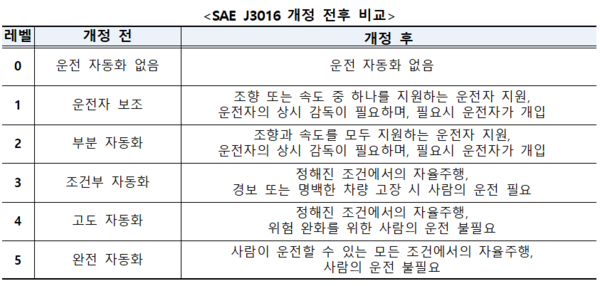
The revision specified the existing descriptions for each level of autonomous driving based on the roles of the driver and the vehicle. It clarified that Level 1 supports either steering or speed, and Level 2 supports both functions. Both levels require the driver to provide constant supervision and to intervene when necessary.
It defined Level 3 as a stage in which autonomous driving is possible under specified conditions, but a person must drive in the event of an alert or an obvious vehicle failure. Level 4 is a stage in which a person does not need to drive to reduce risk under specified conditions, and Level 5 is a stage in which the vehicle drives without driver intervention under all conditions in which a person can drive.
The SAE J3016 2026 revision, which includes these changes, was officially published on Sept. 20. The ministry said it expects the revision will allow automakers, parts and software companies, and regulatory, insurance and related bodies to use less ambiguous criteria for developing autonomous driving functions and safety design.
A ministry official said, "As autonomous driving services expand, the importance of clear standards that are used internationally is increasing." The official added, "We will continue to actively support South Korea so it can lead international standards in the autonomous driving field."
 Jin-ho Lee
jhlee26@d-today.co.kr