
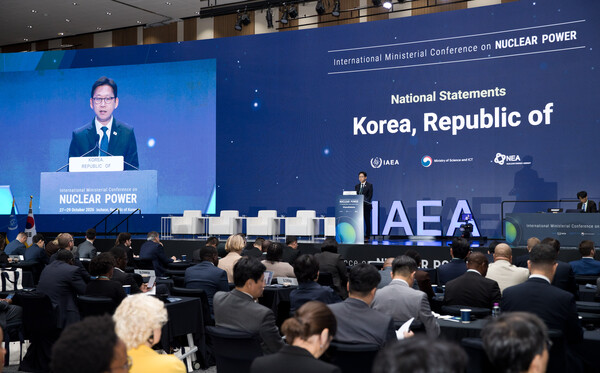
The International Atomic Energy Agency (IAEA) nuclear ministerial meeting, held in South Korea for the first time, closed on Oct. 29 after a three-day schedule.
The meeting drew about 800 participants, including government representatives from 62 IAEA member states, five international organisations and officials from about 85 companies at home and abroad. Delegates discussed measures for the safe use of nuclear power, institutional preparation for applying new technologies such as small modular reactors (SMRs), workforce training and international cooperation.
In the areas of introducing and building new nuclear power plants, policy consistency, the independence of regulators and predictability of project costs and schedules were presented as key tasks. On financing, participants discussed risk sharing among governments, companies and investors, and linking the IAEA's readiness reviews for nuclear power adoption with investment support from financial institutions such as the World Bank Group.
In the SMR and advanced reactor fields, key issues included verifying performance and economic feasibility through demonstration and operation, securing market demand, preparing licensing and sharing early investment risks. Participants also stressed the need to improve laws and systems to expand nuclear technology to maritime, offshore and remote areas, and to build systems for nuclear fuel supply and radioactive waste management.
Participants also shared ways to use AI to improve the safety and operating efficiency of nuclear facilities. Participating countries introduced cases of applying AI to support inspections and knowledge management, and discussed conditions for safe use such as performance verification, data management and cybersecurity. They confirmed the principle that final responsibility for safety-related decision-making rests with humans.
South Korea shared its accumulated experience in nuclear power plant development and operations through a session titled "A New Era of Nuclear Energy." It also introduced plans for regulatory frameworks and securing specialised personnel to introduce digital twin and AI monitoring technologies in line with existing safety requirements. The Ministry of Science and ICT operated a "K-nuclear special promotion hall" during the meeting, showcasing domestic nuclear technologies including large reactors, SMRs, next-generation reactors and research reactors.
Deputy Prime Minister and Minister of Science and ICT Bae Kyung-hoon (배경훈) said, "This meeting was an occasion to explore the future of nuclear energy together and to lay the foundation for policy, technology and industrial cooperation based on safety and trust." He said, "South Korea will use K-nuclear technology and experience to expand opportunities for the next generation, sharing with the world the benefits of peaceful use as a model nuclear power country."
 Jin-ho Lee
jhlee26@d-today.co.kr