
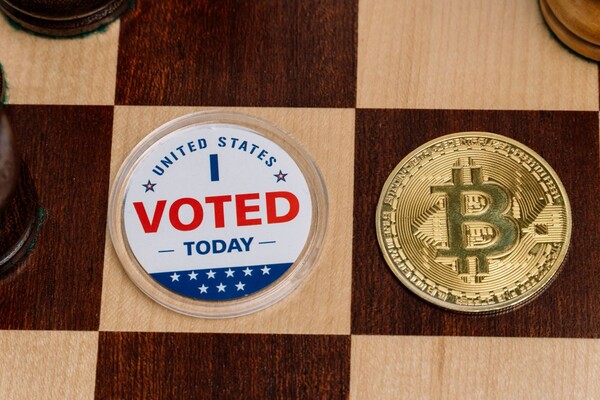
Bitcoin’s “election premium” in the options market ahead of the U.S. midterm elections is much lower than it was during the 2024 presidential election.
On Oct. 29, blockchain media outlet CryptoSlate reported this, citing an analysis by derivatives research firm Block Scholes. The analysis compared option prices on Oct. 26, 2026 and Oct. 28, 2024, each eight days before the election.
Annualised forward implied volatility for the 7 to 14-day window that includes this year’s election day was 37.8 percent. It was higher than the subsequent 14 to 30-day window at 35 percent and the 30 to 60-day window at 37.7 percent. The volatility premium attached to the election window was 2.8 percentage points and 0.1 percentage points, far below 14.4 percentage points and 10.8 percentage points in 2024. That means the options market is pricing in less additional volatility from the election than in 2024.
The link between the election outlook and bitcoin prices was also not clear. Block Scholes analysed changes in the probability of Democrats taking control of the Senate on prediction market Kalshi and bitcoin daily returns through Oct. 26 this year. The average correlation coefficient was -0.02. That means the analysis found little tendency for the two indicators to move together.
Even so, it is hard to conclude that investors have become less cautious or that price stability has improved simply because the election premium is low. There remains a possibility that prices react sharply to an unexpected election result. The analysis also said the different nature of this year’s midterms and the 2024 presidential election should be considered.
The rate environment also differs. The U.S. Federal Reserve cut rates in September ahead of the 2024 presidential election, but this year it raised rates in September and then held them on Oct. 28. That is one reason it is hard to expect the post-election uptrend seen in the past to be repeated this time.
It pointed out that for this U.S. midterm election to become a catalyst for bitcoin gains, expectations from political change need to translate into sustained buying. The analysis said focus should be on actual buying demand and the rate outlook, rather than the election itself.
 Yoonseo Lee
yslee@d-today.co.kr