
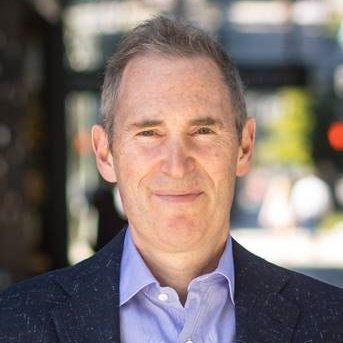
[Digital Today reporter Chi-gyu Hwang] "Because AI models can find far more vulnerabilities than people, companies need to rewrite almost all code so agents can handle it."
Amazon CEO Andy Jassy (앤디 재시) recently appeared on the venture capital firm Andreessen Horowitz (a16z) YouTube channel. In a conversation with a16z co-founder Ben Horowitz and general partner Erik Torenberg (에릭 토렌버그), he stressed that anxiety about AI models has been focused on scenarios close to science fiction, while there has been too little discussion about the immediate risk of cybersecurity.
"Right now, when a vulnerability is found, people classify it and create a patch. Even if you rush to finish that process, it usually takes a long time before actual deployment because of intertwined dependencies between systems. It is hard to keep up with the pace at which AI finds vulnerabilities in this way," he said.
He added that patch deployment will need to be finished within minutes in the future. He said there is no chance of winning in the new world unless applications are rewritten so agents can update them.
In the conversation, Jassy also shared views beyond AI-era security, including rebuilding supply chains after the pandemic, political debate around data centres, in-house chips Graviton and Trainium, investments in stakes in Anthropic and OpenAI, and a reorganisation of the Alexa division.
Under the Andy Jassy era, now entering its fifth year, Amazon revenue has increased by about 80 percent and the size of Amazon Web Services (AWS), its cloud business unit, has nearly tripled.
AWS's AI business reached an annualised revenue run rate of $25 billion in three years. That is hundreds of times faster than AWS in its early days. Amazon also plans to pour $220 billion into capital spending this year.
Jassy recalled an anecdote from an executive morning meeting 15 years ago, when everyone found it hard to believe news that a telecommunications company had spent $50 billion on capital investment. "The numbers now are truly astonishing, but it is still not enough," he said. "Even after spending $220 billion this year, we cannot meet all the demand."
He explained AI demand using a barbell shape. At one end are AI research and development companies that are consuming computing power on an unprecedented scale, along with a handful of hit apps such as ChatGPT and Claude Code. At the other end are companies using AI to cut costs and raise productivity, such as in customer service, fraud detection and work automation.
The biggest market by AI usage, Jassy said, is the middle of the barbell: production workloads that companies are already running. Most of that area has not yet applied AI broadly.
Costs are a sensitive issue there, he said. "The cost of inference, when a trained model actually produces answers, has come down significantly over several years but it is still 10 times more expensive," he said. "To remake existing apps for AI, companies need to be confident the effect will exceed the cost they put in. When inference costs go down, that threshold also falls, and in the end all apps become smarter and more capable."
He also shared views on organisational change driven by AI. As companies grow, roles become increasingly specialised and people see that as how it should be to grow a big company, but he said that does not fit the AI era.
He also projected fewer people will be needed for the same work. "It does not mean we will not need people, but the era of increasing headcount as the organisation grows is over, and new jobs will fill that space in AI, robotics and the space sector," he said. "If AI handles 80 percent of the work, one person can move across multiple jobs and teams will become smaller," he added. "Every team will start work from a much more advanced point than before, and will be able to make new things faster and more."
 Chi-gyu Hwang
delight@d-today.co.kr