
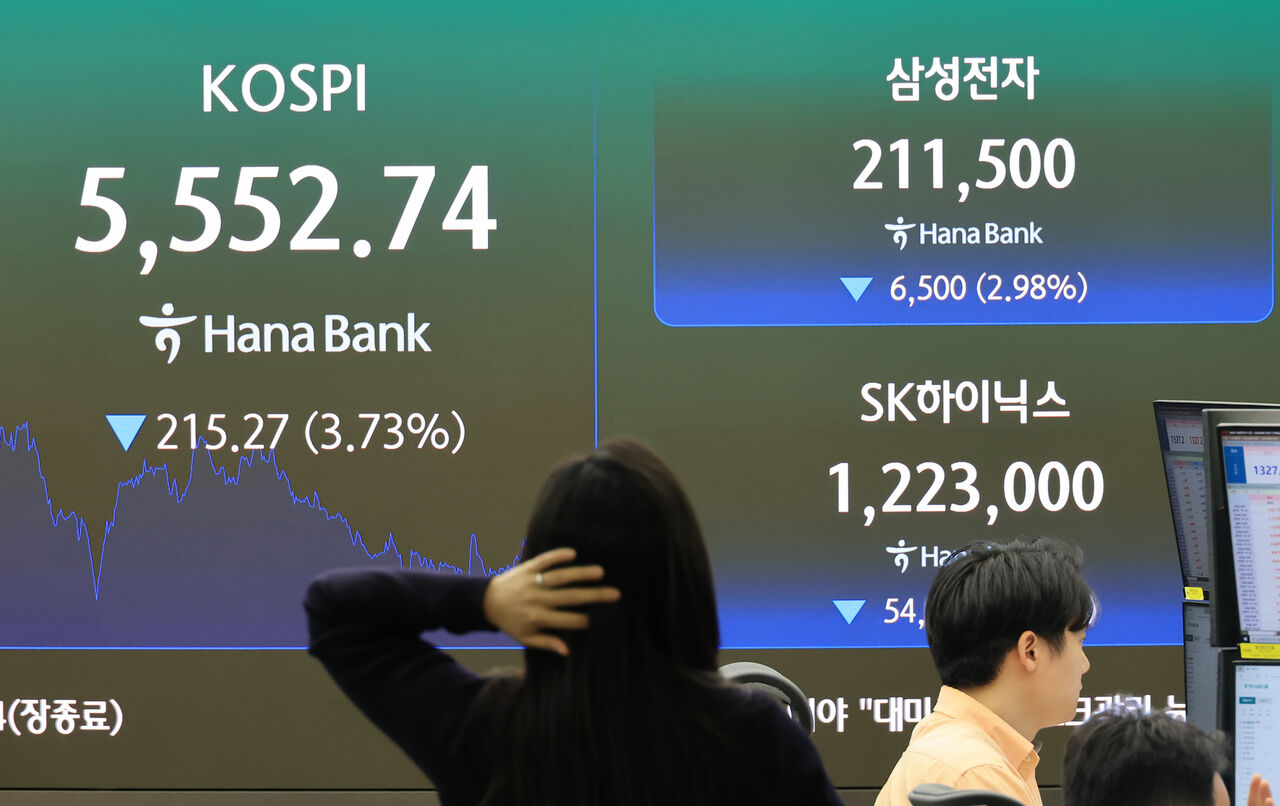
South Korean stocks this week are expected to test the possibility of a rebound as investors check the U.S. Federal Open Market Committee (FOMC) and earnings from major companies at home and abroad. With doubts lingering over the profitability of artificial intelligence (AI) investment, semiconductor results and future investment plans are expected to shape market sentiment.
According to the Korea Exchange, the KOSPI on Oct. 23 closed up 16.53 points, or 0.30 percent, at 5,550.30 from the previous session. It fell as far as 5,305.98 during the session but rebounded as bargain buying flowed in, led by Samsung Electronics and SK Hynix.
The KOSDAQ, however, ended down 1.62 percent at 751.69. Foreign investors were net sellers of 98.3 billion won on the KOSPI, while institutions were net buyers of 86.8 billion won.
In the previous U.S. session, stocks were weighed down by rising international oil prices. On Oct. 23, the Dow Jones Industrial Average fell 1.2 percent to 52,215.16, the S&P 500 dropped 0.5 percent to 7,623.68 and the Nasdaq fell 0.2 percent to 25,955.34. Brent crude rose above $116 a barrel and the U.S. 10-year Treasury yield neared 5 percent, limiting appetite for risk assets.
South Korean stocks have recently undergone another sharp correction following July. The KOSPI plunged 7.57 percent in a single day on Oct. 15 and has since swung widely around the 5,500 level. Investor sentiment has weakened sharply as worries over AI investment profitability coincided with high interest rates and foreign selling.
Market attention in particular is shifting from revenue growth at AI companies to investment costs and financing capacity. Meta's credit default swap (CDS) premium rose to a record high after it announced a plan to expand AI infrastructure investment. Credit risks at AI-related companies with high reliance on borrowing, including CoreWeave and Oracle, also came into focus.
The industry sees the market entering a phase of verifying whether large-scale investment can translate into actual cash flow and profits, rather than AI demand itself having collapsed.
Revenue and demand at AI companies have remained firm, but companies expanding investment through borrowing are facing a higher bar than before in a high interest rate environment, it said.
This week, those concerns will be tested again through corporate earnings. In South Korea, SK Hynix will announce third-quarter results on Oct. 28. SK Hynix is scheduled to hold its earnings release and conference call at 9 a.m. that day.
The market is expected to focus not only on the size of operating profit but also on high bandwidth memory (HBM) and server memory demand, as well as future capital expenditure and shareholder return plans. With recent memory prices and AI server demand remaining firm, results and an outlook that meet market expectations could restore semiconductor investment sentiment that had sharply deteriorated.
Samsung Electronics will release final third-quarter results on Oct. 29. Samsung Electronics will hold its earnings release and conference call at 10 a.m. that day. Details that were hard to confirm in the preliminary results, including performance by division, expansion of HBM supply and the outlook for memory prices, are expected to be disclosed.
Whether the two companies return capital to shareholders is also a focus from a supply-and-demand perspective. With foreign selling continuing, it has become important whether share buybacks or higher dividends by large semiconductor firms can absorb additional selling. If earnings and shareholder returns are confirmed at the same time, large semiconductor stocks could help support the lower end of the market.
U.S. big tech earnings are also in focus. Microsoft will report on Oct. 28 local time, and Amazon and Intel·SanDisk will report on Oct. 29. Microsoft, in particular, is expected to draw market attention not only for AI and cloud growth but also for the scale of AI infrastructure investment such as data centres.
What the market is seeking to confirm in big tech earnings is not simply revenue growth. As AI facility investment continues to rise, it has become important whether revenue and cash flow keep pace with the speed of investment growth.
If profitability is confirmed as investment expansion continues, AI investment sentiment could recover. If borrowing and investment burdens only grow, the recent risk-off trend could persist.
Monetary policy is also an important variable. The U.S. Federal Reserve will hold the FOMC on Oct. 27 to 28 local time to decide its benchmark interest rate. The outcome can be confirmed early on Oct. 29 Korea time.
Markets largely expect the Fed to keep rates unchanged, but with the recent rise in international oil prices increasing inflation burdens again, attention is expected to focus on the Fed's future rate path.
If oil prices and interest rates stabilise at the same time, the macroeconomic burden that has weighed on stocks recently could ease. If international oil prices remain high and the Fed leaves open the possibility of further tightening, valuation pressure could rise again, led by AI and growth stocks.
Valuation pressure in South Korean stocks has already eased significantly. The KOSPI's 12-month forward price-to-earnings ratio has fallen to the low 4 times level, while forward earnings per share are above 1,300 points. As share prices fell faster than corporate earnings forecasts, valuations alone suggest the market has entered a historically undervalued range.
Many assessments say it is difficult to expect an immediate V-shaped rebound based on low prices alone. The recent market problem is closer to supply and demand and credit risk than corporate earnings. Foreign selling has not fully subsided, and AI-related credit spreads and international oil prices remain high.
By sector, it is necessary to first look at companies confirming results, centred on semiconductors. Even after the recent correction, demand for memory and AI servers is holding up, so if results from SK Hynix and Samsung Electronics do not show signs of an industry slowdown, semiconductors could stand at the centre of a rebound.
If financing burdens for AI investment continue to be highlighted, stock price differentiation is expected to widen further between large companies with high cash generation and companies with high reliance on borrowing. The market is likely to continue focusing on actual revenue, cash flow and investment capacity rather than a simple link to AI.
In the end, the key for this week's market is whether the FOMC can ease rate anxiety and whether domestic and overseas semiconductors and big tech can prove the sustainability of AI investment through earnings. If both conditions are confirmed, the KOSPI could attempt a rebound by raising its lows around the 5,500 level.
If oil and interest rate burdens persist and doubts about the profitability of AI investment are not resolved, high volatility is likely to continue for some time.
Park Gi-ryang (박기량), a senior researcher at Samsung Securities, said, "It is difficult to expect a V-shaped sharp rebound in the short term, but the worst 악재 has already been substantially priced in." He added, "A strategy of approaching step by step after confirming the formation of a solid downside support line is effective."
Lee Kyung-min (이경민), a researcher at Daishin Securities, said, "The core of the market lies in micro rather than macro." He added, "It is necessary to watch whether trust in the sustainability and profitability of AI investment can be strengthened through big tech earnings."
Lee Jae-won (이재원), a researcher at Yuanta Securities, said, "Now is the time to re-verify existing investment judgments through earnings rather than joining pessimism." He added, "An approach is needed to increase weightings centred on companies that have delivered results."
 Oh Sang-yup
yub@d-today.co.kr