
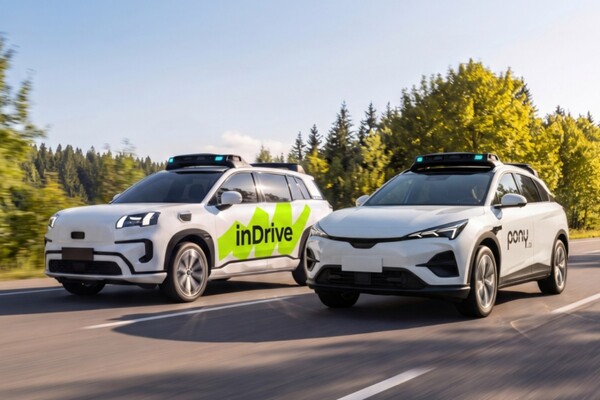
[Digital Today reporter Jinju Hong] Ride-hailing platform inDrive will work with Chinese autonomous driving company Pony.ai and Nvidia to launch robotaxi test runs in Kazakhstan in 2027. The robotaxi market, which has grown mainly in the United States and China, is expanding into emerging markets such as Central Asia.
On Oct. 23 local time, IT outlet TechCrunch reported that inDrive plans to start robotaxi tests in the first half of 2027 in Astana, the capital of Kazakhstan.
The partnership is being pursued based on a memorandum of understanding to review ways to connect Pony.ai’s robotaxis to inDrive’s ride-hailing platform. If the plan goes ahead, Pony.ai will supply its seventh-generation robotaxis, and inDrive will operate the service through its app. Nvidia plans to provide artificial intelligence technology, including its Hyperion platform and Halos safety system.
The test operations will initially be conducted with safety operators onboard. inDrive has a long-term goal of fully driverless operation.
Yury Misnik inDrive chief technology officer (CTO) said the company’s business structure was designed from the outset to be asset-light. The idea is to improve the customer experience by working with multiple partners across various markets. It is a strategy of expanding services by partnering with outside technology companies rather than building both vehicles and autonomous driving technology in-house.
In this partnership, Nvidia’s role is to reduce the burden of building autonomous driving systems. Nvidia is focusing on cutting the time and cost of developing such systems from scratch by providing a foundation that can integrate sensors and computing technology.
Ali Kani, vice president of Nvidia’s automotive business, stressed that these cost reductions are especially important in emerging markets. He said that in markets where ride-hailing fares are already low, autonomous driving services also need to be price-competitive.
inDrive is a platform with strengths in relatively low-cost mobility services. As a result, in its robotaxi business, not only adopting technology but also lowering operating costs and keeping user fares competitive is expected to be a key challenge.
The Kazakh government has also begun working on systems to introduce autonomous driving services. Kazakhstan last month announced plans to launch autonomous taxi services in 2027 and said it would push initial tests in three cities, including Astana. It also prepared related rules so autonomous vehicles can be tested on some public roads.
The regulatory environment is a key condition inDrive considers when selecting future markets to enter. Misnik said the company is also reviewing other markets and that a friendly regulatory environment supporting safe and sustainable road tests is important.
Astana is also a city with a challenging environment for verifying the performance of autonomous driving technology. With a population of about 1.7 million, Astana has long periods of snow and ice in winter, and road conditions and changing weather can put pressure on autonomous driving systems.
Arsen Tomsky inDrive founder and chief executive officer (CEO) said testing in Astana will be an opportunity to evaluate autonomous driving technology in harsh winter conditions. He said local driving results could serve as reference material when expanding services to other regions with similar climate and road conditions.
Pony.ai is also pursuing global expansion beyond China. The company set a goal of operating more than 3,500 robotaxis in more than 20 cities worldwide by the end of 2026. That would be a sharp increase from 1,975 as of the end of June this year.
inDrive’s review of autonomous driving business is not limited to Kazakhstan. The company signed a separate contract with Saudi Arabia’s AI Driver last December and reviewed deploying autonomous vehicles using technology from Chinese autonomous driving company WeRide. It said at the time it planned to push pilot operations starting in Riyadh in the first half of 2026, but it has not been confirmed whether the test operations have begun.
inDrive currently operates services in more than 1,200 cities across 47 countries. Beyond ride-hailing, it is also expanding into areas including delivery, intercity travel and financial services.
If the Kazakhstan test proceeds as planned, inDrive will gain a chance to validate its robotaxi business in Central Asia. But key challenges remain for an actual service rollout, including complying with local regulations, ensuring safety in harsh climates and establishing a cost structure that can compete with existing ride-hailing services.
 Jinju Hong
hongjj@d-today.co.kr