
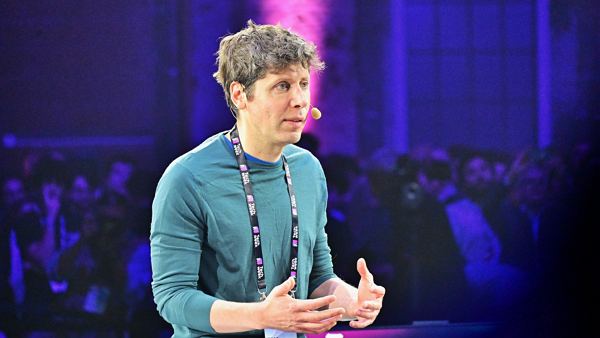
[Digital Today reporter Yoonseo Lee] Sam Altman (샘 알트먼) said the mood among scholars who felt a sense of crisis after OpenAI moved into mathematics has shifted toward accepting artificial intelligence (AI).
On Oct. 22 local time, Business Insider reported that Altman said in a recent Stanford lecture that the mathematics community moved from distrust and anger to a stage of acceptance.
Altman said the mathematics community was deeply shocked right after OpenAI began making a full-scale effort to solve hard mathematical problems. On the first day, some reactions said mathematics was over, and there were even comments urging graduate students to change majors. He added that about three days later, this turned into backlash saying it was terrible for OpenAI to do such a thing.
Altman said the mood changed after a few days. He said many mathematicians began to see that they could build more research careers in a different way by using AI. He explained that AI is becoming an indispensable tool in mathematical research and in reviewing proofs.
Despite this optimism, concerns in academia remain. OpenAI announced in September that it had solved the 'existence and smoothness' problem of the Navier-Stokes equations, a representative hard mathematical problem. Controversy then arose over how the research results were produced and disclosed, and over the impact on academia.
Whether research by New York University and Anthropic researchers was used in OpenAI’s problem-solving also became an issue. OpenAI said it did not view the researchers’ chat logs and that related records did not affect the model. Some in academia also pointed to the burden on humans to understand and verify results produced by AI.
The controversy also spread to academic events. A 'mathathon' planned by California Institute of Technology undergraduates and others is a competition in which participants use AI to take on hard mathematical problems. After more than 700 scholars and students opposed it, saying it could mass-produce hasty and insufficiently verified AI outputs, OpenAI withdrew its sponsorship. Organisers later supplemented verification requirements and the event is scheduled to be held in November.
Concerns are also continuing about rapid changes in research methods. Terrence Tao (테런스 타오), a mathematician at UCLA, said this month that the 'romantic era' of mathematics was over after OpenAI announced it had solved more than 700 additional problems. He pointed to a shift from a traditional approach in which outstanding researchers individually solved hard problems to a workflow of verifying AI’s results, and said there are things lost in the process.
Altman drew a line, saying AI’s employment shock would not lead to the end of jobs. He said a situation in which jobs themselves disappear would not come, even if companies reorganise their workforce in line with adopting AI. He nonetheless acknowledged that the pace of change in mathematics was far faster than in other industries or academic fields. He said it was the first time he had seen a case in which a field moved so quickly through shock and backlash to acceptance.
Debate in the mathematics community is expanding beyond AI’s problem-solving ability to the role of researchers and responsibility for verification. Along with moves to use AI as a new research tool, how to maintain humans’ role in understanding and verifying results is emerging as a key issue.
 Yoonseo Lee
yslee@d-today.co.kr