
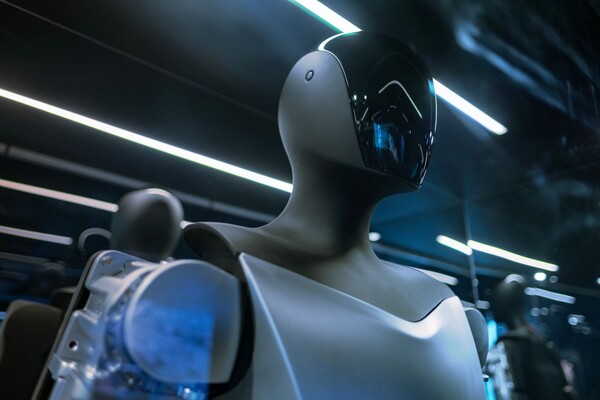
Tesla has begun initial production of its humanoid robot Optimus, but challenges remain before it can be deployed in real industrial settings. Elon Musk (일론 머스크) put the timing for deliveries to outside customers at the end of 2027.
On Oct. 22 (local time), Tesla and multiple foreign media outlets reported that Musk said in a third-quarter earnings call that Tesla had begun producing Optimus on a mass-production line at its Fremont, California factory.
Tesla said the robots produced on the line were the first to meet mass-production quality standards. It has also finished installing most of the equipment for the line, which was designed for an annual output target of 1 million units. But reaching a production level of 20,000 units a week is expected to take at least a year. With some designs and parts still being improved, the start of production does not mean large-scale supply or readiness for real-world use.
Musk said Tesla must improve artificial intelligence, electromechanical design, safety, reliability and durability before deliveries to outside customers. A key hurdle is the hands, which need to handle delicate objects like a person while withstanding repeated use. The robot cannot self-heal like human skin, so it needs a design that will not wear out even with long-term use.
Securing AI training data is also a challenge. Unlike Tesla cars, Optimus lacks a large base of real-world use, making it difficult to collect enough task data. Tesla is pursuing a plan to build 10,000 to 20,000 robots, have them repeatedly learn tasks at an 'Optimus Academy,' and use the data to improve AI. It plans to equip the robots with an AI5 chip around April 2027. Musk also said he would release video within a month or two showing a robot performing tasks that were not pre-programmed.
The initial area of use is expected to be industrial sites rather than homes. Musk presented dangerous or repetitive tasks and jobs that require 24-hour operation as priority applications. Ken Goldberg (켄 골드버그), a professor at the University of California, Berkeley, said it was uncertain whether the robot's software and self-learning capabilities would work sufficiently in real environments. It is difficult to confirm consistent performance required in the field based on demonstration videos alone, he said.
The commercialisation timeline has also been pushed back from past targets. Musk previously mentioned possible internal use in 2025 and supply to external companies in 2026, but this time he set late 2027 for deliveries to outside customers. Rivals are also moving into production and field deployment. China's Xpeng plans mass production of its humanoid robot Iron by the end of 2026 and deliveries in the first half of 2027. Boston Dynamics has begun producing an electric Atlas and is training it for assembly work at Hyundai Motor factories.
The start of Optimus production means Tesla has entered a phase of building a mass-production system. But the key to commercialisation is not only output volumes but also securing hand precision and durability, AI that can respond to new tasks, and reliability that can keep the robot operating continuously on site.
 Seung-a Yoo
ysah@d-today.co.kr