
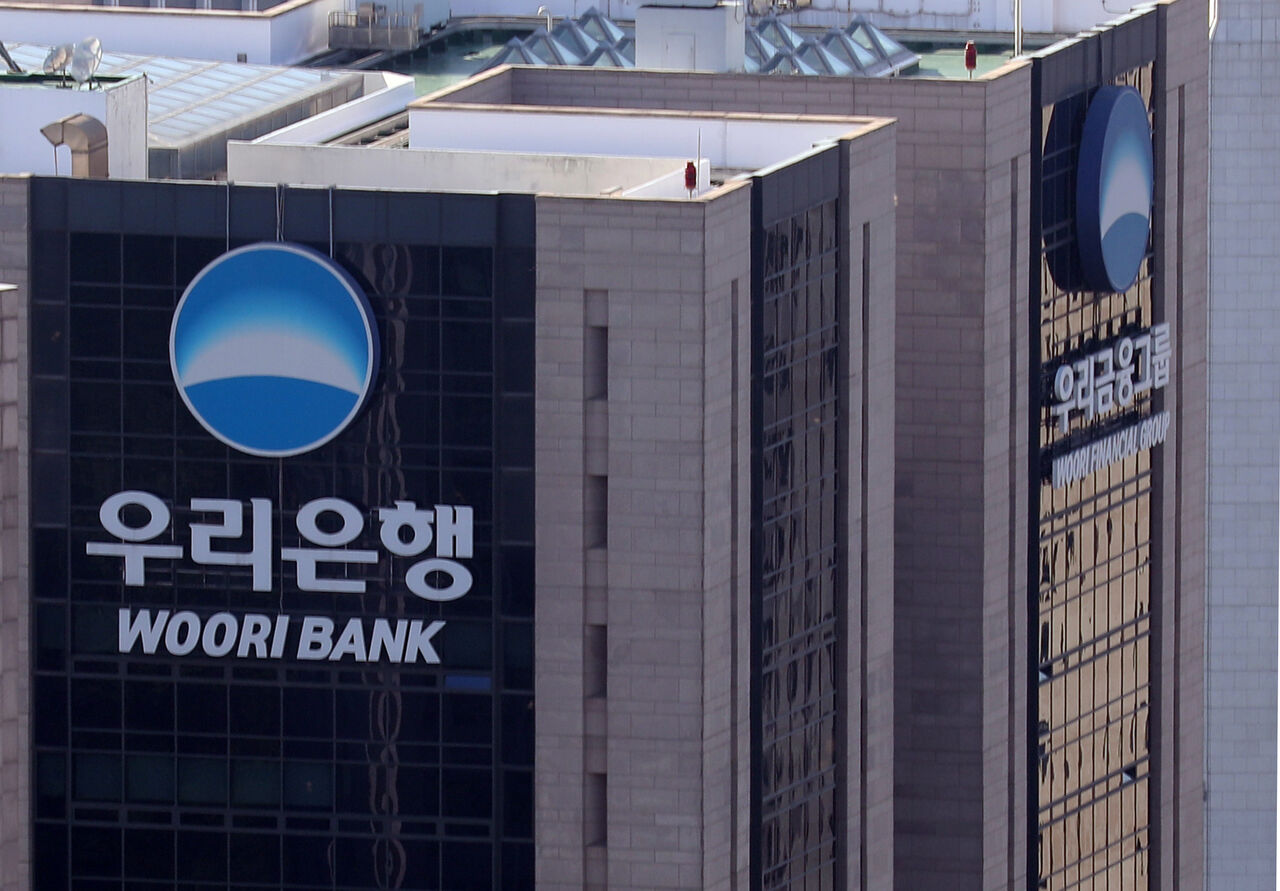
Woori Bank rebounded after weak results in the first half of this year, posting net profit of more than 1 trillion won in the third quarter. Cumulative net profit, which had been down from a year earlier through the first half, also returned to growth. The recovery was supported by higher cumulative net interest income from expanded corporate lending, higher non-interest income in the third quarter and easing loan-loss provision burdens. Its net interest margin (NIM) decline and a rise in delinquency remain burdens for profitability and soundness management going forward.
Woori Financial Group's third-quarter earnings release on Thursday showed Woori Bank's third-quarter net profit was 1.03 trillion won, up 22 percent from the previous quarter. It was the highest quarterly result on record. Net profit for the first nine months was 2.40 trillion won, up 4.7 percent from 2.29 trillion won a year earlier.
That marked an exit from the earnings slump that had continued through the first half. Woori Bank posted first-half net profit down 11.9 percent from a year earlier, a relatively weak result among major commercial banks. One-off burdens in the first quarter, including provisions related to overseas subsidiaries and costs for voluntary retirement, weighed on results, and net profit recovered in the second quarter as those related costs eased.
The third quarter extended the improving trend, allowing the bank to turn to year-on-year growth on a cumulative basis as well. It effectively made up for the first-half slump with the increase in third-quarter profit.
Corporate lending expansion and lower provisions lift profit, while NIM falls.
The recovery was influenced by growth in loan assets centered on corporate finance. Woori Bank's cumulative net interest income for the first nine months was 6.20 trillion won, up about 7.0 percent from 5.80 trillion won a year earlier. It came as the bank managed household lending under a total volume management stance while pushing asset growth centered on corporate lending.
As of end-September, Woori Bank's won-denominated loans stood at 313 trillion won, up 4.1 percent from the end of last year. Corporate loans rose 4.2 percent over the same period. Woori Financial said it strengthened its net interest income base by expanding lending centered on high-quality companies, including in advanced strategic industries.
Woori Financial said Woori Bank pursued an "All-in Margin" strategy to secure not only loan interest but also foreign exchange and investment banking (IB) fees as it expanded corporate lending. Of about 12.6 trillion won of increased won-denominated loans this year, large corporate loans accounted for about 8 trillion won. Woori Financial said the expansion of transactions with large companies contributed to some NIM burden but also had the effect of increasing related fee income.
Despite the increase in loan assets, interest margins fell. Woori Bank's third-quarter NIM was 1.434 percent, down 0.072 percentage point from 1.506 percent in the previous quarter. The gap between lending rates and funding rates narrowed as funding costs rose.
Woori Financial said a key reason for the NIM decline was that about 70 percent of Woori Bank's loans are linked to the CD rate. It said a widening gap between long- and short-term interest rates and rising funding rates lowered NIM by about 0.05 percentage point, while a decline in the share of core deposits contributed about 0.02 percentage point to the fall.
Market rate changes presented by Woori Financial in a conference call showed that as of end-September, the CD (certificate of deposit) rate rose 0.41 percentage point from a year earlier, while the 1-year bank bond yield rose 1.32 percentage points. The company said the widening gap between long- and short-term rates affected the bank's third-quarter NIM decline.
Lower loan-loss provisioning burdens also supported improved results. Woori Bank's third-quarter credit loss cost was about 145.0 billion won, down 44.7 percent from the previous quarter. Cumulative credit loss cost for the first nine months was 757.6 billion won, down about 6.4 percent from 809.0 billion won a year earlier. Over the same period, operating profit before provisions rose 5.0 percent to 3.86 trillion won from 3.68 trillion won. With revenue up and provisioning burdens easing, cumulative operating profit rose 8.2 percent from a year earlier to 3.11 trillion won.
At the group level, credit loss costs also declined. Woori Financial's third-quarter credit loss cost was 314.0 billion won, down 28.5 percent from the previous quarter, and cumulative credit loss cost was 1.28 trillion won, down 15.7 percent from a year earlier. The group's credit cost ratio fell 0.10 percentage point to 0.42 percent from 0.52 percent a year earlier.
Despite the rebound, rising delinquency rates pose a soundness management task.
Some asset soundness indicators worsened despite the earnings improvement.
Woori Bank's delinquency rate at the end of the third quarter was 0.46 percent, up 0.10 percentage point from 0.36 percent a year earlier. The group's non-performing loan (NPL) ratio also rose to 0.72 percent from 0.70 percent, while the NPL coverage ratio fell to 112.7 percent from 130.0 percent.
The decline in credit loss costs contributed positively to near-term profit improvement, but given the rising delinquency rate trend it is difficult to rule out the possibility that provisioning burdens could expand again.
Woori Financial said in a conference call that new bad loans are declining as the bank reshapes its loan portfolio centered on high-quality corporate lending. Based on that, it reaffirmed its goal to cut group credit loss costs by about 15 percent from a year earlier and manage the credit cost ratio in the low 0.40 percent range this year.
Whether profit growth in corporate finance continues while a recovery in NIM and asset soundness management can be supported will likely determine the durability of the earnings recovery.
Kwak Sung-min (곽성민), vice president and CFO of Woori Financial Group, said in a conference call on Thursday, "In the fourth quarter, NIM can at least be maintained or rebound slightly," adding, "From 2027, if asset repricing accelerates in earnest, we expect it to enter an improving trend."
He added, "At the group level as well, as lending increases centered on large corporate loans, new bad loan formation is also declining, so we expect to be able to manage credit loss costs stably in the future as well."
 Ji-young Lee
ljy@d-today.co.kr