
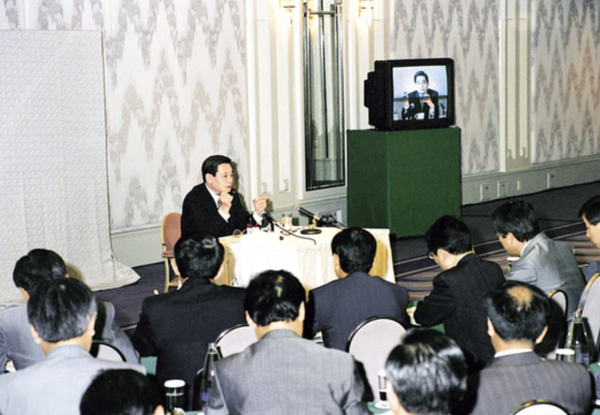
A memorial service marking the sixth anniversary of the death of former Samsung Electronics chairman Lee Kun-hee (이건희) was held on Thursday at the family burial site in Suwon, south of Seoul. Samsung Electronics said on the day that Lee left achievements in semiconductors, management and cultural heritage. Lee entered the semiconductor business in 1974 by investing personal assets in Korea Semiconductor, which was suffering a funding crunch. At the time, South Korea’s electronics industry relied on overseas technology for key components.
Samsung entered the memory semiconductor business in earnest in 1983, following founder Lee Byung-chul’s Tokyo Declaration. It built a factory in six months, compared with the usual 18 months, and developed a 64K DRAM product that year. In 1992, it released the world’s first 64M DRAM. About 20 years after entering the business, it rose to No. 1 in the global memory semiconductor market the following year.
Such pre-emptive investment during downturns became Samsung’s approach. In 1984, as rivals expanded 4-inch wafer lines, Samsung switched to 6-inch wafers. In 1987, it built a new production line even as Japanese companies were cutting investment. In the 1990s, it was the first to establish an 8-inch mass-production system. Lee foresaw that computers, software and robots would change the industrial landscape.
Samsung Electronics said preparation for future technologies, which Lee emphasised, is leading to new industrial competitiveness. It said the decision to choose semiconductors half a century ago became the foundation for competitiveness in the AI era. As AI technology advances, the importance of high-performance memory also grows. Samsung Electronics’ DRAM market share in the second quarter of 2026 was 39.4%, the world’s highest. Its NAND share was also No. 1 at 29.3%. NAND is a storage device that retains data even when the power is off.
It also pursued talent and organisational innovation. Lee called for recruiting talent regardless of nationality and background, and in 1990 supported employees’ overseas stays through a regional specialist programme. After declaring New Management in Frankfurt in 1993, it introduced a 7 a.m. start and 4 p.m. finish system, and a line-stop system that halts production when defects occur. In 1995, it disposed of about 50 billion won worth of defective mobile phones and other items.
Cultural assets and artworks donated in April 2021 to the National Museum of Korea and the National Museum of Modern and Contemporary Art, Korea total about 23,000 pieces. They were items Lee collected over his lifetime. Cumulative visitors to the domestic touring exhibition of the "KH Collection" exceeded 3.5 million, setting the highest record among single-collection exhibitions. The overseas tour is being held at the British Museum from Oct. 1 after stops in Washington and Chicago. It is the museum’s large-scale special exhibition of Korean art for the first time in 42 years since 1984.
 Dae-geon Seok
d2dg@d-today.co.kr