
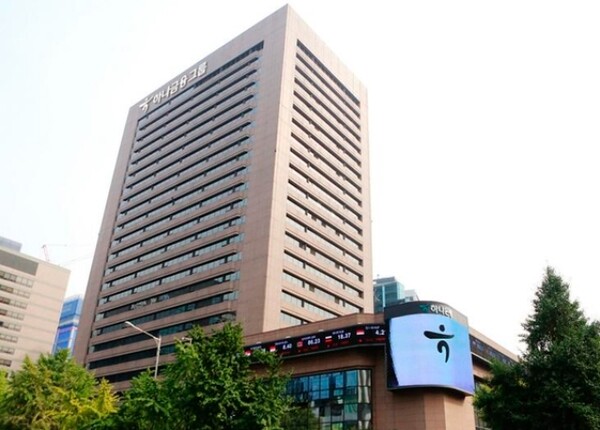
Hana Financial Group posted more than 3.6 trillion won in net profit through the third quarter this year, helped by an increase in fee income from its wealth management and investment banking (IB) businesses. It kept quarterly net profit at the 1.2 trillion won level this year and decided to expand its share buyback and cancellation programme to 949 billion won, the largest annual level on record.
Hana Financial said on Thursday its consolidated net profit for the first nine months of the year rose 5.6 percent, or 190.9 billion won, from a year earlier to 3.62 trillion won. Third-quarter net profit was tallied at 1.22 trillion won.
The group's cumulative core profit for the first nine months came to 9.63 trillion won, up 14.2 percent, or 1.20 trillion won, from a year earlier. Interest income totalled 7.48 trillion won and fee income 2.14 trillion won.
Fee income, in particular, rose 29.8 percent from a year earlier, leading the earnings improvement. As fee revenue expanded mainly in wealth management and IB, the share of fee income in core profit increased by 2.7 percentage points to 22.3 percent from 19.6% a year earlier.
Key unit Hana Bank posted consolidated net profit of 3.32 trillion won for the first nine months, up 5.8 percent, or 182.4 billion won, from a year earlier. Third-quarter net profit was tallied at 1.19 trillion won.
Hana Bank's cumulative fee income was 874 billion won, up 11.5 percent, or 90.4 billion won, from a year earlier, marking a record high for the first nine months. Fees related to retirement pensions and bancassurance increased, and growth in foreign exchange fees and foreign exchange trading gains also contributed as the bank expanded its customer base for export-import transactions.
The bank's cumulative interest income was 6.78 trillion won, and core profit including fee income came to 7.65 trillion won. Net interest margin (NIM) in the third quarter was tallied at 1.57 percent.
Among non-bank units, Hana Securities posted net profit of 283.4 billion won for the first nine months. Hana Card and Hana Capital earned net profit of 175.3 billion won and 144.5 billion won, respectively.
The group's asset quality and cost indicators also stayed at stable levels. Its credit cost ratio for the first nine months was 0.30 percent, and the cost-to-income ratio (CIR) improved by 0.38 percentage points from a year earlier to 38.38 percent.
The common equity tier 1 (CET1) ratio, a capital adequacy indicator, was estimated at 13.45 percent as of the end of the third quarter, up 0.18 percentage points from the previous quarter. This was above the 13 percent or higher target presented in Hana Financial's "Corporate Value Enhancement Plan 2.0". Return on equity (ROE) was 10.62 percent and return on assets (ROA) was 0.71 percent. The estimated Bank for International Settlements (BIS) capital ratio was 15.45 percent.
Hana Financial will also expand shareholder returns based on improved earnings and capital capacity. Its board approved an additional 250 billion won in share buybacks and cancellation and a third-quarter cash dividend of 1,165 won per share. The dividend per share was up 26.6 percent from a year earlier.
Including 699 billion won in shares already bought back through the third quarter and the newly approved 250 billion won, the group's share buyback and cancellation programme will total 949 billion won this year. That is a 25.8 percent increase from 754.1 billion won last year and the largest annual amount on record.
Hana Financial plans to continue pushing capital efficiency and expanded shareholder returns under its "Corporate Value Enhancement Plan 2.0" announced in July. It also plans to expand productive finance and inclusive finance in connection with relocating the group headquarters to Cheongna in Incheon, and to strengthen support for the real economy and people's livelihoods.
 Ji-young Lee
ljy@d-today.co.kr